Poster
Client Context
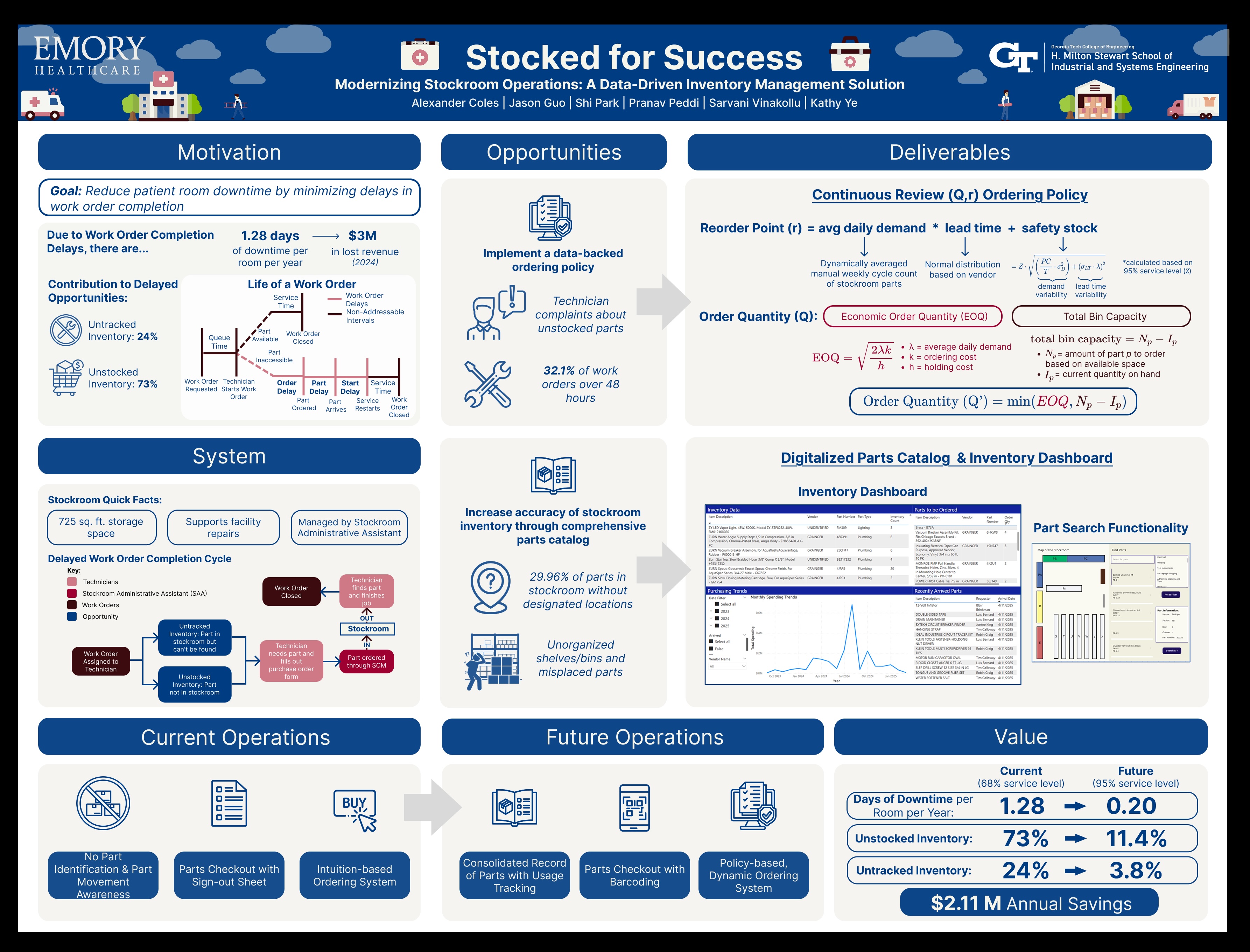
Emory University Hospital Midtown, located in the heart of Atlanta, contains over 600 beds and treatments across 28 different specialties. One key team at the hospital is the facilities management department, which is responsible for repairs and maintenance within the hospital. The department uses a 725-square-foot storage space to store parts needed to complete repairs. The project focused on optimizing the stockroom’s operations to better support facility repairs and reduce patient room downtime.
Executive Summary
Emory University Hospital Midtown is one of Georgia’s leading hospitals, serving thousands of patients annually within the Atlanta area. This project supports the facilities management department in maintaining the hospital’s infrastructure by using parts from their stockroom to prevent room downtime in the hospital and avoid interruptions in patient care. The stockroom lacks real-time inventory tracking, resulting in delays associated with procurement and locating needed parts.
This project enhances stockroom operations through inventory management by implementing real-time inventory tracking and establishing a structured ordering policy. These improvements reduce stockouts and streamline procurement processes to ensure that technicians have ready access to needed parts. By improving their inventory management, the facilities management department can reduce room downtime caused by delays in work order completion that result from inaccessible parts.
The team developed an inventory dashboard that includes a dynamic ordering policy and parts catalog. The inventory dashboard consolidates multiple data sources and provides real-time visibility into stock levels through the parts catalog. The ordering policy is designed to analyze part usage trends and vendor lead times to determine optimal reorder points and quantities. By integrating these solutions, the project improves the department’s work order completion time by minimizing delays.
To build the dashboard and inventory policy, the team identified part descriptions and locations, conducted weekly inventory counts to track stock turnover rates, and structured purchasing and inventory databases as well as a parts catalog. The team integrated barcode scanning technology into the inventory system and dashboard to facilitate real-time stock level updates, improving visibility for the stockroom administrative assistant (SAA).
The inventory dashboard, managed by the SAA, provides an integrated part search tool, purchasing trends, real-time stock tracking, and automated part order recommendations based on a (Q, r) ordering policy. This system dynamically adjusts reorder points and order quantities based on average demand trends collected from the barcode scanning system. The combination of these elements ensures a more dynamic and data-driven inventory management process.
By implementing these deliverables, the facilities management department will have consistent visibility into stockroom operations. The integration of a barcode scanning system and a centralized dashboard will sustain long-term improvements in inventory management. These improvements will support Emory’s mission of delivering high-quality patient care by improving operational efficiency and reducing patient room downtime.
Project Information
Student Team
- Kathy Ye
- Sarvani Vinakollu
- Jason Guo
- Pranav Peddi
- Shi Park
- Alexander Coles
Faculty Advisor

Faculty Evaluator