Poster
Client Context
Emory’s LTAC facility is a specialized-care hospital, with a maximum capacity of 50 patients, designed to treat patients who require intensive, specialized, and rehabilitative care for an extended period. Emory LTAC is renowned for its expertise in respiratory and wound care and is the only long-term acute care hospital in the nation to hold the Joint Commission Gold Seal Certifications in three categories: respiratory care, wound care, and sepsis. Emory LTAC has historically treated around 45 patients at any given time and is beginning to slowly return to similar service levels following decreases during the Covid-19 pandemic. Emory LTAC averages 40 discharges per month and the average patient stay is around 30 days, which means Emory LTAC is treating around 480 patients per year. During their stay, patients are treated by various nurses, respiratory and rehabilitation specialists, and patient care technicians (henceforth referred to collectively as staff or caretakers), that provide care based on the patient's diagnosis.
Executive Summary
The client, Emory Healthcare’s Long-Term Acute Care (LTAC) Hospital, located in Decatur, GA, is the only facility in Atlanta specializing in long-term acute care. With 50 patient rooms split between the fourth and fifth floors of the facility, Emory LTAC is renowned for its expertise in intensive respiratory and wound care and rehabilitation. Emory LTAC utilizes centralized stockrooms on the two patient floors to store supplies and serve as a restocking hub for staff. Currently, staff members visit the stockroom as needed to transfer supplies to a patient’s room for treatment. Once a patient is discharged, any remaining supplies in the patient’s room must be discarded due to Infection Prevention (IP) protocols.
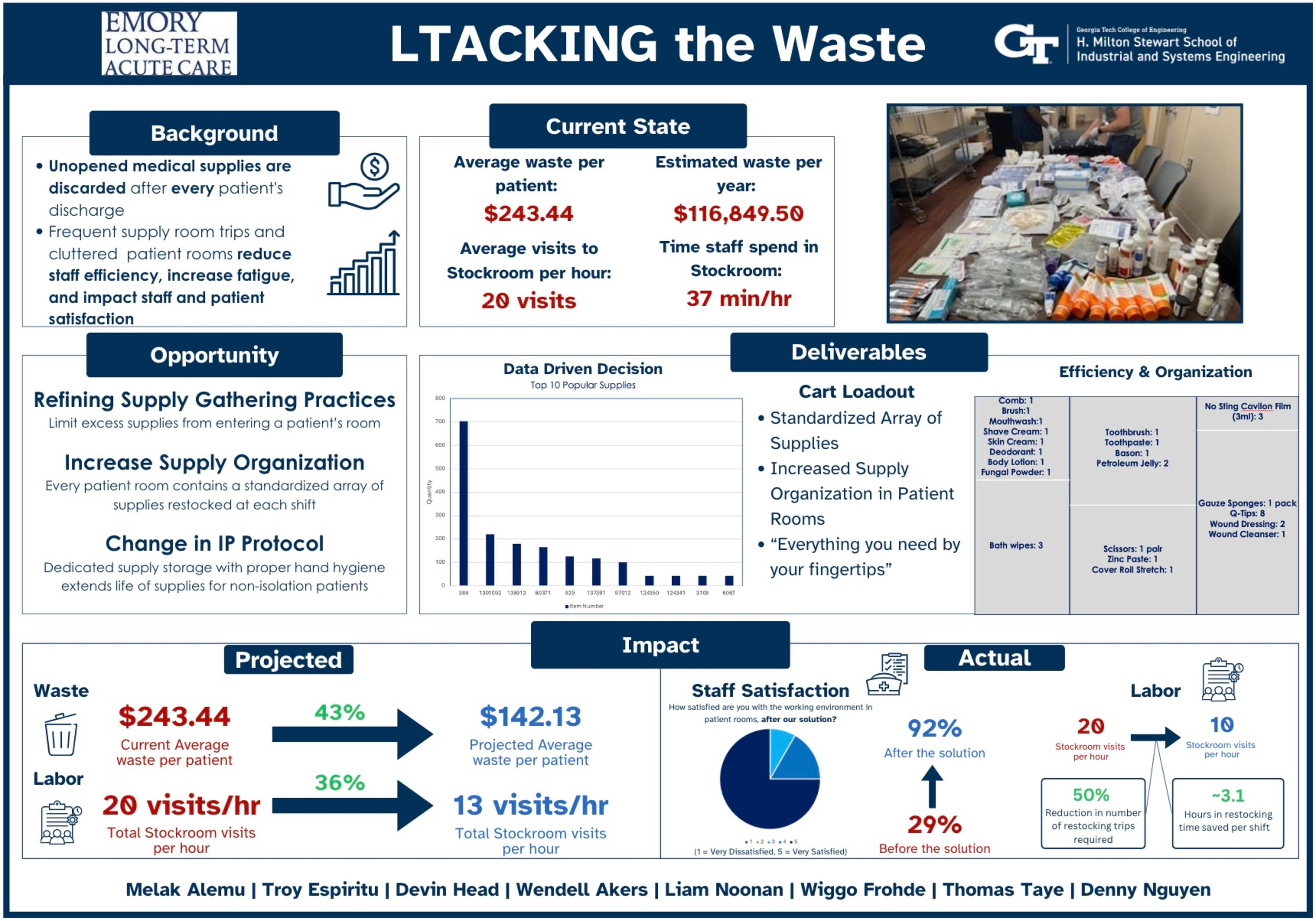
Emory LTAC is currently facing financial risks and staff dissatisfaction in their workflow. Due to the general disorganization of a patient’s room, staff often forgo familiarizing themselves with the supplies in a patient’s room before treatment, opting instead to visit the stockroom to obtain the supplies that they believe are necessary. Staff members frequently obtain more supplies than necessary, and even supplies that may already be in the patient’s room, in an effort to provide quality care to the patient by minimizing future trips to the stockroom. Pre-implementation data collection showed that caretakers conducting rounds cumulatively visit the stockroom 20 times per hour on average and the average patient’s discharge results in $243.44 worth of unused medical supply waste.
After conducting pre-implementation analysis via supply waste collections, time studies, supply room observations, and staff satisfaction surveys, the team moved into the implementation phase with the goal of reducing supply waste and improving staff satisfaction. The team designed a periodic review inventory system in which a bedside supply cart is used as a decentralized stockroom within the patient room. The carts, one to each patient room, contain a standardized array of supplies that are routinely replenished to their respective par levels by staff at the end of their shift to prepare for the next. The cart “loadout”, including the selection, quantity, and location of supplies, was determined by partnering with nursing leaders and other LTAC staff in conjunction with waste and labor data analysis. Post-implementation data collection validated the new system, showing a decrease in wasted supplies of 48% per patient, as well as a 50% decrease in the cumulative number of visits to the stockroom during rounds. These values represent $56,300 in annual supply waste savings and 3.7 hours redirected from stockroom visits per shift respectively. Additionally, staff reported a 63% increase in satisfaction regarding the organization of patient’s rooms, up from 29% to 92%, among other promising survey responses.
Project Information
Student Team
Melak Alemu
Thomas Taye
Liam Noonan
Troy Espiritu
Wiggo Frohde
Denny Nguyen
Devin Head
Faculty Advisor

Faculty Evaluator