Poster
Client Context
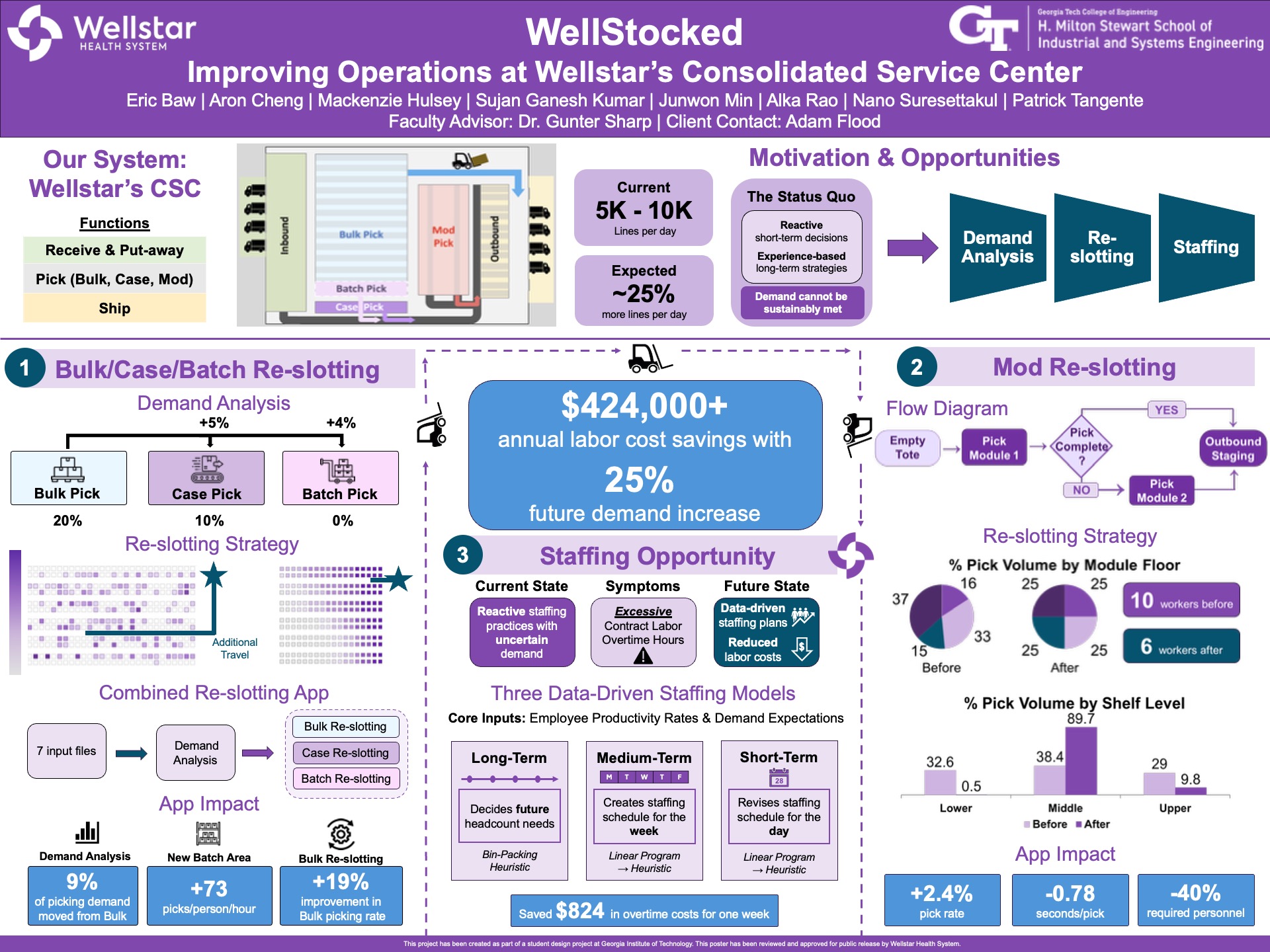
Wellstar Health System is one of Georgia’s largest non-profit healthcare organizations with 10 hospitals, 5 health parks, and 400+ physician offices. The specific system of interest for this project is the Wellstar Consolidated Service Center (CSC) in Lithia Springs, Georgia. This 135,000 square-foot distribution center ensures that medical supplies are procured, packaged, and shipped to meet next-day delivery expectations across the Wellstar network. The CSC handles 5,000 to 10,000 lines of facility orders per day, which are picked from three different zones: high-velocity Case Picking, small-item Module Picking, and large-item Bulk Picking.
Executive Summary
The CSC is expecting a demand increase of 25% more lines per day from Wellstar’s hospital expansions. This volume cannot be sustained under the current experience-based practices which rely heavily on reactive decision making, expensive contract labor, and excessive overtime. Additionally, inventory slotting across all three zones does not reflect actual demand patterns, resulting in unnecessary travel and inflated labor requirements. The team’s approach to this problem centered on two strategies: re-slotting across the different picking zones and improving staffing decision, both informed by picking data and facility layout constraints.
Key recommendations include the implementation of a new Batch Picking area carved out from the Bulk Picking space to offload 9% of total picking demand away from slow Bulk Picking operations. Additionally, a distance-based re-slotting of the Bulk Pick area relocates the highest-velocity SKUs closest to the inbound/outbound point, reducing travel time and improving picking rates by 19%. The Case Pick zone was similarly re-slotted to reflect demand patterns. In the Mod Pick area, an ergonomic re-slotting strategy concentrates high-frequency items at waist and shoulder level shelves, yielding a 2.4% improvement in picking rate.
These operational improvements are complemented by three staffing models that provide the CSC leadership with a structured workflow to support labor decisions across three time horizons: long-term headcount planning, medium-term weekly scheduling, and short-term daily adjustments. Pilot testing on the week of January 12th demonstrated that the staffing models could eliminate all overtime for that period, generating nearly $700 in savings for a single week.
The projected annual value of these improvements exceeds $424,000 in labor cost savings while successfully accommodating the 25% expected demand increase. Deliverables include three applications for the CSC leadership to re-slot the different picking zones and make staffing decisions using the picking data. All deliverables have been deployed and handed off to Wellstar.
Project Information
Student Team
Eric Baw, Aron Cheng, Mackenzie Hulsey, Sujan Ganesh Kumar, Junwon Min, Alka Rao, Nano Suresettakul, Patrick Tangente
Faculty Advisor

Faculty Evaluator