Poster
Client Context
Neighborhood Cooperative Ministries (NCM) is a non-profit organization that aids families in Gwinnett County with food, clothing, and money for rent and utilities. NCM is supported by twenty-three local churches and numerous businesses. They serve about 50-70 families each day from a 12,000-foot facility.
Project Objective
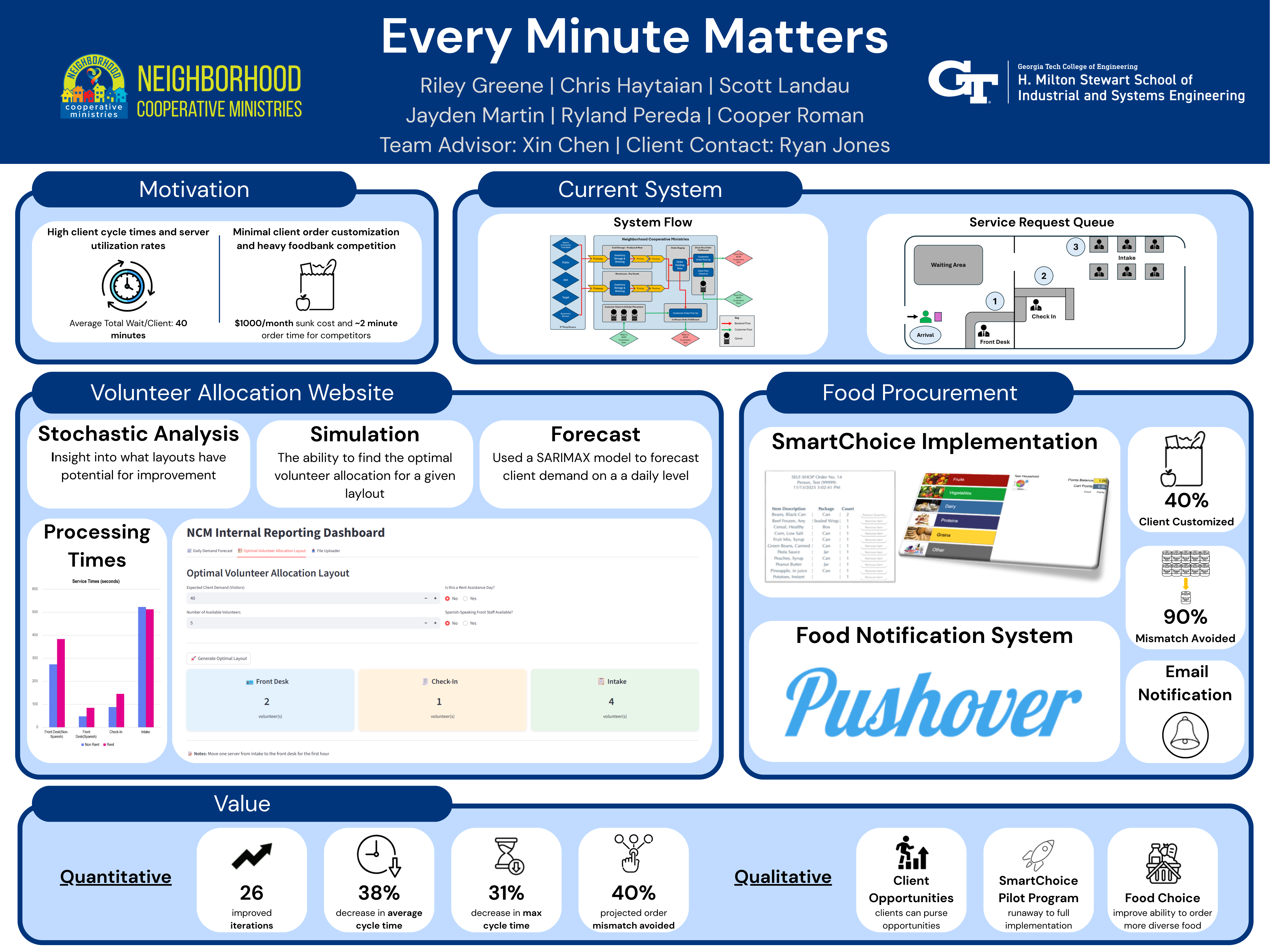
With rising demand and constrained resources, NCM is experiencing growing wait times of over 40 minutes and needs to serve clients more efficiently. Previous solutions have been difficult to maintain, contributing to operational inefficiencies and missed opportunities for impact. This is why our objective is to enhance operational efficiency while delivering a better overall experience for our clients. The team identified three key opportunities: the first was improving the queuing process and two centered on reviving past projects. The first opportunity is a forecasting model that estimates daily client demand used alongside a queuing model that optimizes volunteer allocation to reduce station utilization and improve flow. The remaining two opportunities stem from past senior design projects that were never fully implemented or have stopped functioning since prior implementation. The first is SmartChoice, an electronic platform that streamlines the client's intake and selection process, which NCM is currently paying $1,000 per month for but not actively using. The second is a Food Notification System, designed to alert the warehouse manager when partner food banks have surplus inventory.
Design Strategy
The team used a straightforward, data-driven approach to develop and test each solution. We began by observing NCM’s operations, collecting arrival and service-time data, and meeting with staff to understand daily challenges. Using this information, we built models that could give us distributions on different parts of the system. Each idea was validated either through historical data analysis, simulations, or small pilot programs to make sure it was practical for NCM’s volunteers, technology resources, and day-to-day workflow. This method ensured that every deliverable was both effective and realistic for NCM to implement.
Deliverables
The team’s first deliverable was to create a Daily Volunteer Allocation Website created fully in Python and hosted on Streamlit’s free Community Cloud platform. Through the website, users can view forecasted daily client volumes, input operational parameters to determine the optimal volunteer layout, and upload arrival data directly from their databases. The team’s next deliverable was a SmartChoice pilot program, allowing us to evaluate its impact and readiness for full-scale implementation. Finally, the team restored the Food Notification System, which had been inactive since July.
Value and Impact
This project was guided by the objective of improving both operational efficiency and overall client experience. Accordingly, every proposed solution is supported by quantitative/qualitative results demonstrating its impact. The primary value of the team’s Volunteer Allocation website is the improved system layout, which projects to reduce the average cycle time by 38% and maximum cycle time by 31%. By better matching distribution to demand, the SmartChoice pilot program reduced total items by 10–15%, helping ensure the 65 pounds of food distributed per visit reflects what clients prefer. These solutions not only improve current operations but also position NCM for scalable growth as community demand continues to rise.
Project Information
Student Team
Riley Greene
Christopher Haytaian
Scott Landau
Jayden Martin
Ryland Pereda
Cooper Roman
Faculty Advisor

Faculty Evaluator