Poster
Client Context
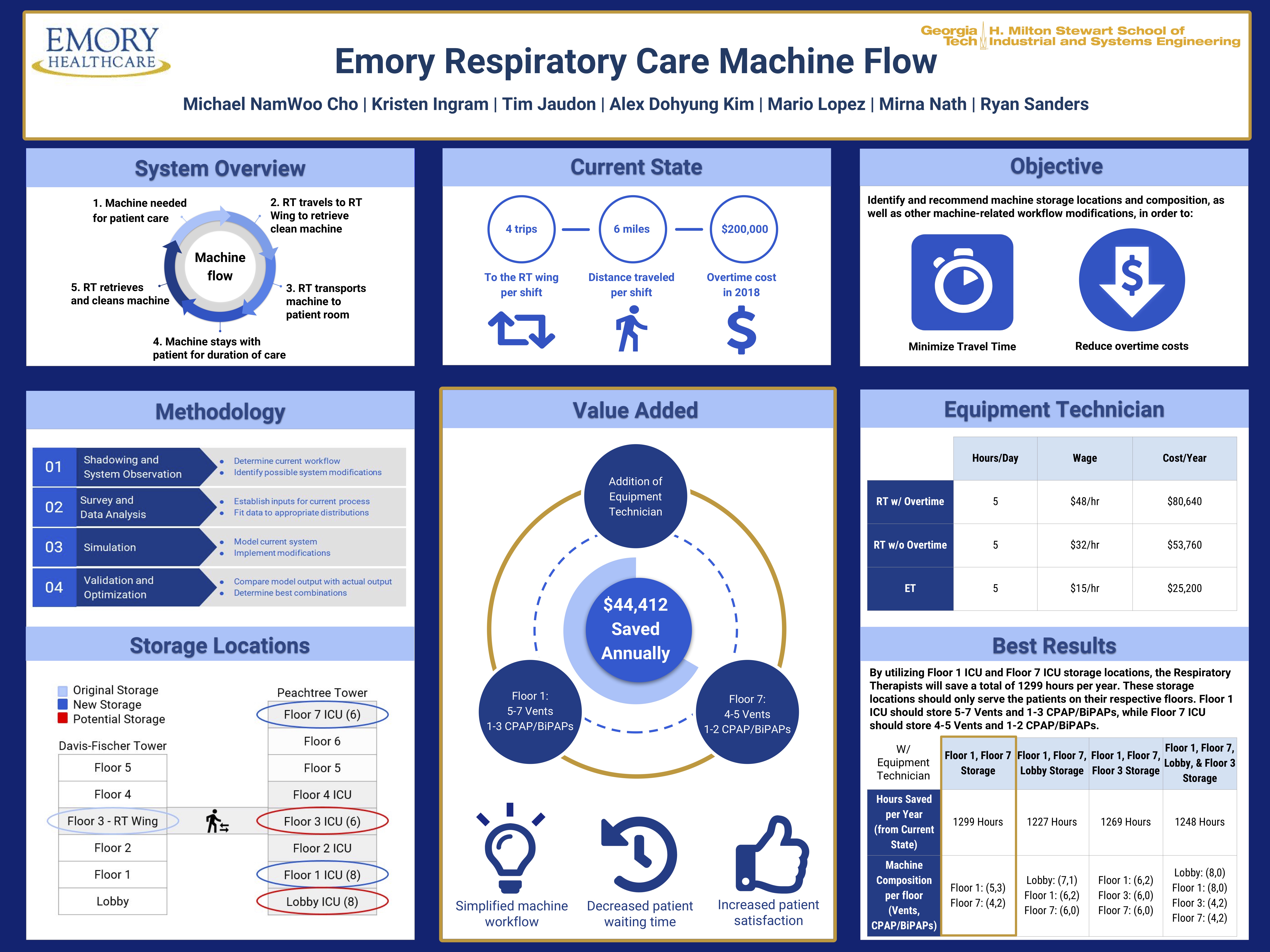
Emory University Hospital Midtown (EUHM) is a hospital system in Atlanta, Georgia. The client for this project, the EUHM Respiratory Care Team, consists of 60 respiratory therapists (RTs). These RTs provide care to a wide range of patients in need of breathing assistance due to chronic breathing disorders, pulmonary infections, or any other issue that may disrupt normal breathing patterns. One of the main ways RTs provide care to patients is through the utilization of respiratory machines such as CPAP/BiPAPs and ventilators.
Executive Summary
Emory University Hospital Midtown (EUHM) is a hospital system in Atlanta, Georgia. Our client, the EUHM Respiratory Care Team, consists of 60 respiratory therapists (RTs). These RTs provide care to a wide range of patients in need of breathing assistance due to chronic breathing disorders, pulmonary infections, or any other issue that may disrupt normal breathing patterns. One of the main ways RTs provide care to patients is through the utilization of respiratory machines such as CPAP/BiPAPs and ventilators.
Many patients who need respiratory machines stay in Intensive Care Units (ICUs). The ICUs are located on 5 floors in EUHM's Peachtree Tower. However, respiratory machines are stored separately on the third floor of the Davis-Fischer Tower in an area referred to as the RT Wing. There is no centralized storage location for machines within the RT Wing, so many machines are left throughout the hallways. Furthermore, there are no additional storage spaces for respiratory machines in the rest of the hospital. Therefore, RTs spend a great deal of time traveling to and from the RT Wing to retrieve and transport machines to patients. Excess time dedicated to retrieving and transporting machines presents the opportunity to save RTs time during their shifts.
By observing RT workflow and analyzing machine flow within the system, our team determined new machine storage locations that reduce the amount of time RTs spend retrieving and transporting machines. We analyzed the effects of various combinations of new machine storage locations through optimization by simulation. We tested the effects of machine composition stored in 4 potential locations, the ICUs those locations will serve, and the introduction a part-time equipment technician who cleans machines for the RTs.
We determined that storing additional machines on Floor 1 ICU, Floor 3 ICU, and Floor 7 ICU and hiring a part-time equipment technician(s) to clean machines can save the Respiratory Care department approximately $47,000 a year. In addition to monetary savings, our recommended solution also increases RT and patient satisfaction. Since RTs spend less time transporting machines and little to no time cleaning machines due to the equipment technician, additional time is available for RTs to care and educate their patients.
Project Information
Student Team
Namwoo Cho
Kristen Ingram
Timothy Jaudon
Dohyung Kim
Mario Lopez
Mirna Nath
Ryan Sanders
Faculty Advisor
Faculty Evaluator