Poster
Client Context
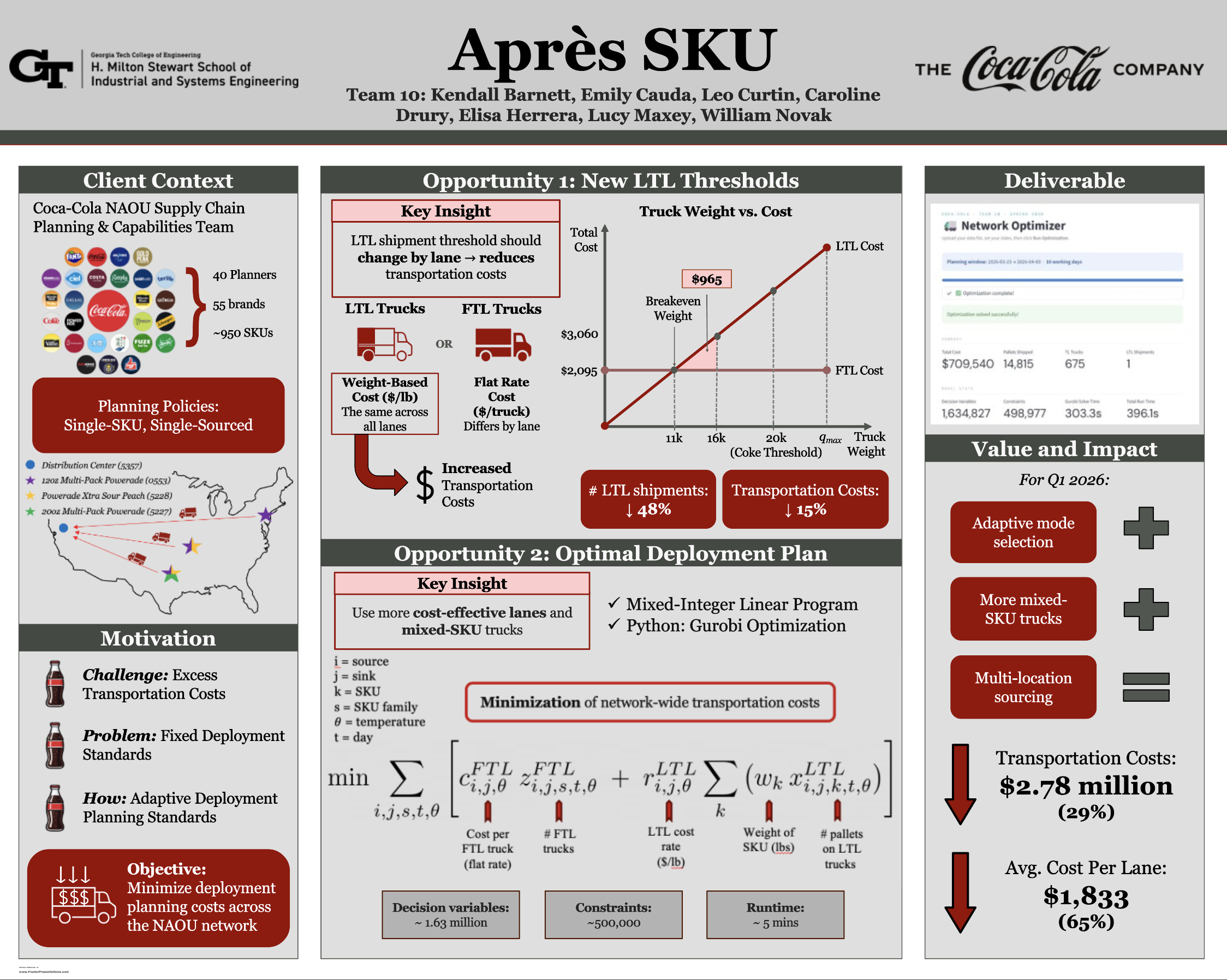
The Coca-Cola Company (“Coca-Cola” or “TCCC”) is a global beverage manufacturer that produces and distributes finished goods and beverage syrups across the United States. This project is in partnership with Coca-Cola’s North America Operating Unit (NAOU), specifically the Supply Chain Planning & Capabilities (SCPC) Team, which oversees the distribution of finished goods between production plants and distribution centers (DCs). The NAOU network consists of 47 production facilities and 43 distribution centers within the contiguous United States, many of which function as both source and sink locations.
Our project focuses on Coca-Cola’s internal stock transfer order (STO) process, which determines how finished goods are sourced and transported throughout the network. The SCPC team manages approximately 40 deployment planners responsible for inventory allocation and shipment planning across roughly 55 brands and 950 SKUs. Coca-Cola currently uses standardized deployment planning and transportation policies across the network; however, these fixed standards do not always account for lane-specific transportation costs and sourcing conditions, contributing to excess transportation spend. Our team was tasked with identifying opportunities to reduce these costs through improved LTL shipment thresholds and more flexible sourcing decisions.
Executive Summary
Coca-Cola is a global beverage manufacturer that produces finished goods and syrups for customers. Within the NAOU, we partnered with the SCPC team to tackle the key challenge of Coca-Cola’s high transportation costs. The NAOU spent over $176 million on stock transfers of finished goods between source and sink facilities in 2025.
Our primary objective is to reduce logistics expenditures by optimizing deployment planning, the strategic internal allocation of finished goods from production plants to distribution centers. The initial opportunity lies within shipment mode selection by refining FTL and LTL criteria. Coca-Cola currently uses a consistent, network-wide weight threshold to dictate mode selection. Because every lane and temperature class has a unique breakeven weight where FTL becomes more cost-effective than LTL, the current uniform standard frequently leads to suboptimal truck loading. By replacing these static rules with dynamic, lane-specific thresholds, we can ensure the best mode is selected for every shipment, thereby capturing significant and recurring transportation cost savings across the network.
Our second opportunity involves creating an optimization model that minimizes network-wide transportation costs. Using a mixed-integer linear program and Gurobi software, the model creates a plan for when and where trucks should be sent and what pallets go on each truck. The model runs by using inputs such as daily inventory and production at plants and demand at sinks, and operates under constraints such as demand satisfaction, supply limits, truck capacities, and dock capacities. The model outputs a biweekly, cost-optimal deployment plan that enables flexible sourcing and incorporates the new LTL weight thresholds.
To support the transition toward full implementation, we provided Coca-Cola with two primary deliverables: the complete optimization model code and the finalized, lane-specific shipment weight thresholds. We will share our filtered and manipulated versions of their data sets to ensure that all findings are transparent and reproducible.
For the period of January through March 2026, our model calculated a total transportation cost of approximately $6.45 million, representing a $2.78 million reduction from the $9.23 million Coca-Cola incurred. This 29.3% decrease was driven primarily by an increased usage of mixed-SKU trucks and a 64.7% decline in the average cost per lane.
Project Information
Student Team
Kendall Barnett
Emily Cauda
Leo Curtin
Caroline Drury
Elisa Herrera
Lucy Maxey
Will Novak
Faculty Advisor

Faculty Evaluator