Poster
Client Context
Novelis Inc. is the world’s largest producer of rolled aluminum products and a global leader in aluminum recycling. The business unit relevant to this project is the Novelis North America Terre Haute plant in Indiana. This plant is a light-gauge (thin) aluminum rolling facility focused primarily on specialty packaging applications such as household foil and food containers. At Terre Haute, large inventory coils (typically 70-85 inches wide) are processed into finished products tailored to customer specifications, with widths ranging from 10-70 inches. Due to significant variation in order requirements including width, gauge, alloy, temper, and coating, the production scheduling process is highly complex. The scheduler must carefully match open sales orders to available inventory coils while simultaneously optimizing material yield, adhering to machine constraints, and meeting delivery deadlines.
Executive Summary
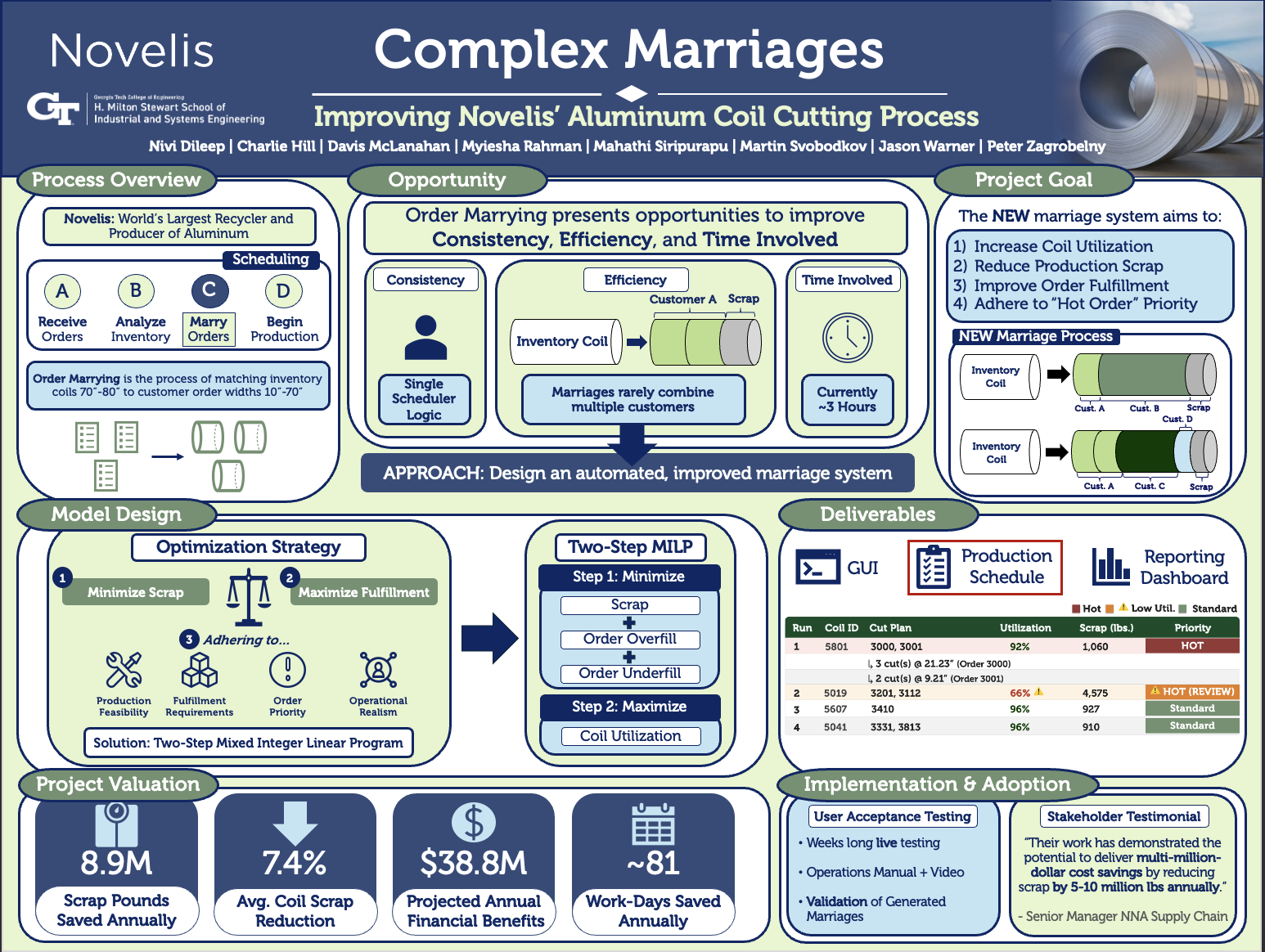
The current production scheduling process is manual, time-intensive, and dependent on a single planner. The main opportunity is improving the balance between reducing scrap and fulfilling priority orders, which is currently based on judgment rather than a systematic method. The process also lacks the ability combine multiple orders on one coil, causing underutilized materials and higher scrap rates. The primary objective of this project was to develop a standardized, optimization-driven framework to reduce material scrap by 3%, decrease daily scheduling time, and improve on-time order fulfillment.
To address these needs, the team designed a two-part Mixed Integer Linear Program (MILP) housed within an intuitive Graphical User Interface (GUI). The model first uses extensive preprocessing to narrow the solution set to feasible pairings, or “marriages.” Part 1 of the MILP makes primary decisions, selecting inventory and order combinations to minimize material scrap while fully filling demand. Part 2 fits partial orders to coils selected in part 1 to maximize utilization of the remaining material. The system replaces a manual, trial-and-error process with optimization that balances scrap reduction against order fulfillment.
The model was validated through User Acceptance Testing (UAT) with plant schedulers to ensure practical and feasible results. Benchmarking against historical production data demonstrates the system improves recovery by over 7% per coil, while accounting for all fixed and engineered scrap plant constraints. This translates to an annual scrap reduction of over 8M lbs., providing the capacity to fulfill an additional 380 orders annually. Converting scrap into finished goods along with cost-avoidance benefits, the project is projected to generate over $32M in additional annual revenue potential, and $7M in cost avoidance at the facility. Furthermore, the system achieves an 83% reduction in manual effort, saving approximately 81 workdays per year.
The project provides a comprehensive suite of deliverables for the Novelis team. The Optimization GUI serves as the central tool for loading data and running the MILP. The Marriage Output and Production Schedule files host the model results and provide the user with actionable daily plans that minimize production scrap while maintaining priority hierarchies and order fulfillment. Finally, a Live Reporting Dashboard tracks performance metrics while offering management a comprehensive view into scrap, throughput, and order fulfillment.
Project Information
Student Team
Charles Hill
Davis McLanahan
Myiesha Rahman
Mahathi Siripurapu
Martin Svobodkov
Jason Warner
Peter Zagrobelny
Faculty Advisor

Faculty Evaluator