Poster
Client Context
Georgia Tech's Academic Success & Advising unit (ASA), housed within the Office of Undergraduate Education & Student Success (OUESS), oversees several non-major specific, specialized Advising Units (AUs) including Pre-Health, Pre-Graduate, and Prestigious Fellowships. These AUs serve Georgia Tech's undergraduate population by connecting students with advisors who support applications to medical school, graduate school, and competitive fellowships such as the Rhodes Scholarship, Goldwater, and NSF GRFP. These advising services are delivered primarily through one-on-one appointments scheduled via Navigate360, Georgia Tech's new, institute-wide advising platform.
Executive Summary
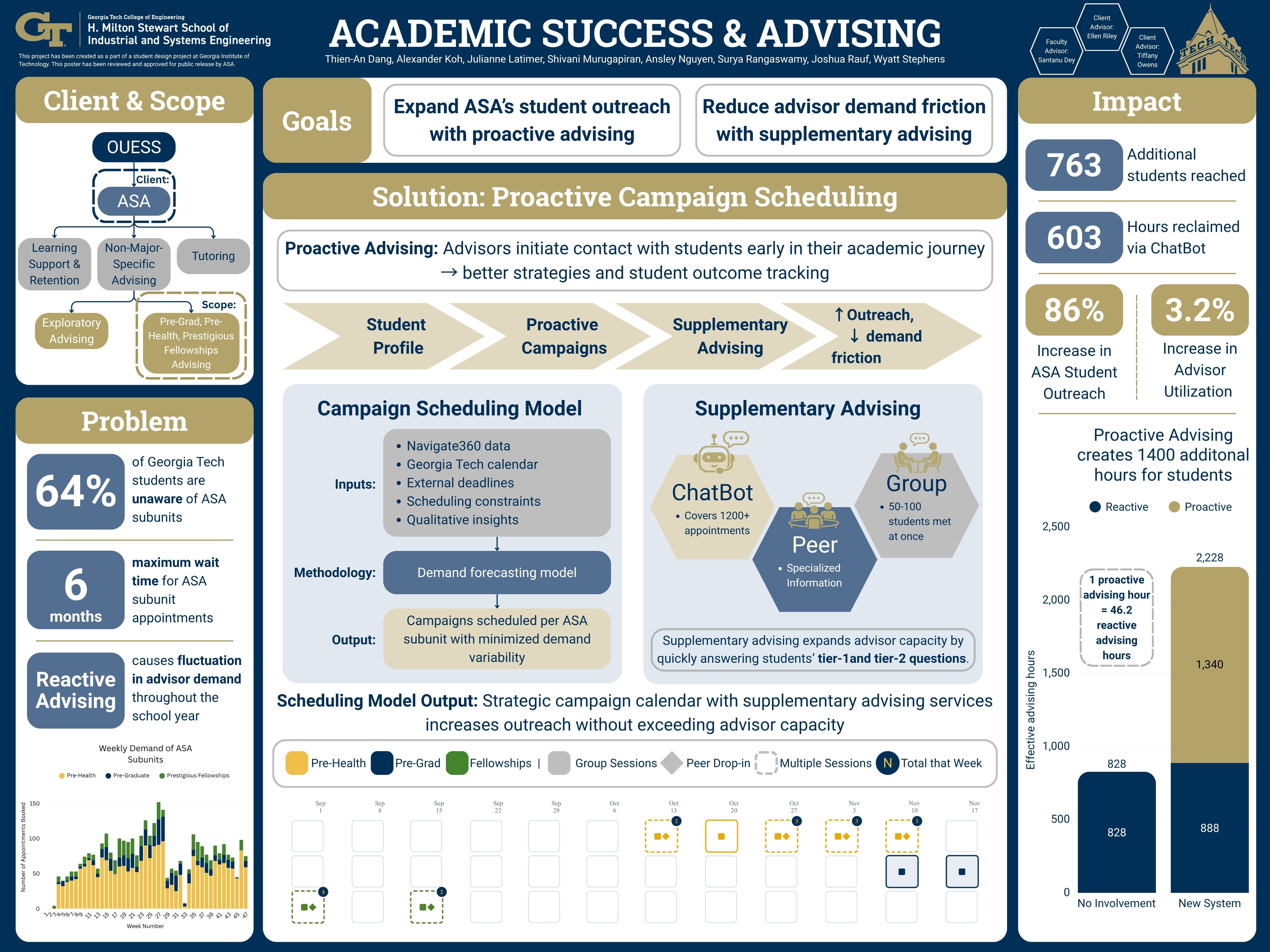
Two barriers prevent students from receiving advising services. First, the AUs rely on a reactive advising model, requiring students to seek out services on their own. However, a recent OUESS survey found 64% of undergraduates were unaware the AUs exist. Second, peak demand periods create long appointment wait times, causing students to abandon the process: 50% of students interviewed reported they would not book an advising appointment with a long wait. These barriers leave a significant portion of the student body without access to services.
To address the barriers, the team developed a recommended campaign scheduling tool that allows the AUs to use a proactive advising system. Students complete an interest form during first-year and transfer student orientations to indicate their interest in receiving advising services; then, these interests are tagged on student profiles in Navigate360, Georgia Tech’s advising platform, which enables advisors to reach out to interested students. To manage the increased workload this outreach creates, the campaign scheduling tool uses historical appointment demand data to forecast future advising demand and find recommended windows to hold campaigns. These include outreach group advising to build awareness, preemptive group advising to reduce peak demand, and peer advising to capture students who may exit due to long wait times. For Fall 2026, the tool recommends 36 sessions distributed across all three AUs, improving demand smoothness by 33.6%.
The projected impact is significant: the proposed schedule reaches 763 additional students in the Fall semester, an 86% increase from the forecasted amount without campaigns, and increases ASA’s share of the student body from 4.62% to 8.62%. Additionally, advisor time is used more efficiently to reach more students. Advisor utilization rises from 42.4% to 45.4% as a result, and the cost per student served drops from 0.934 to 0.556 advisor-hours. The methodology is designed to improve over time as additional semester data accumulates, and these deliverables give ASA a foundation for expanding student reach without overburdening advisors.
Project Information
Student Team
Ansley Nguyen, Joshua Rauf, Julianne Latimer, Noah Koh Surya Rangaswamy, Thien-An Dang, Wyatt Stephens
Faculty Advisor

Faculty Evaluator