Poster
Client Context
The client is Emory University Hospital’s Interventional Radiology Department (EIR) at the Clifton campus. EIR specializes in minimally invasive, image-guided procedures using three imaging modalities: Computed Tomography (CT), Ultrasound (US), and Interventional Radiology (IR). The facility has six procedural rooms: 1 CT, 1 US, and 4 IR. There are nine distinct staff roles: medical doctors (MDs), advanced practice providers (APPs), clinical nurses, procedural nurses, IR technicians, CT technicians, US technicians, and anesthesia teams. EIR receives patient requests on a rolling basis, and they are placed into two distinct queues for each type of patient: inpatients (IPs) and outpatients (OPs). IPs stay in the hospital prior to their appointment with EIR. If a patient’s request for a procedure does not fit in that week’s schedule, then they must wait in the hospital for an available appointment.
Executive Summary
Emory Healthcare’s Interventional Radiology Department (EIR) performs minimally invasive procedures using image-guided technology at the flagship Emory University Hospital (EUH) campus.
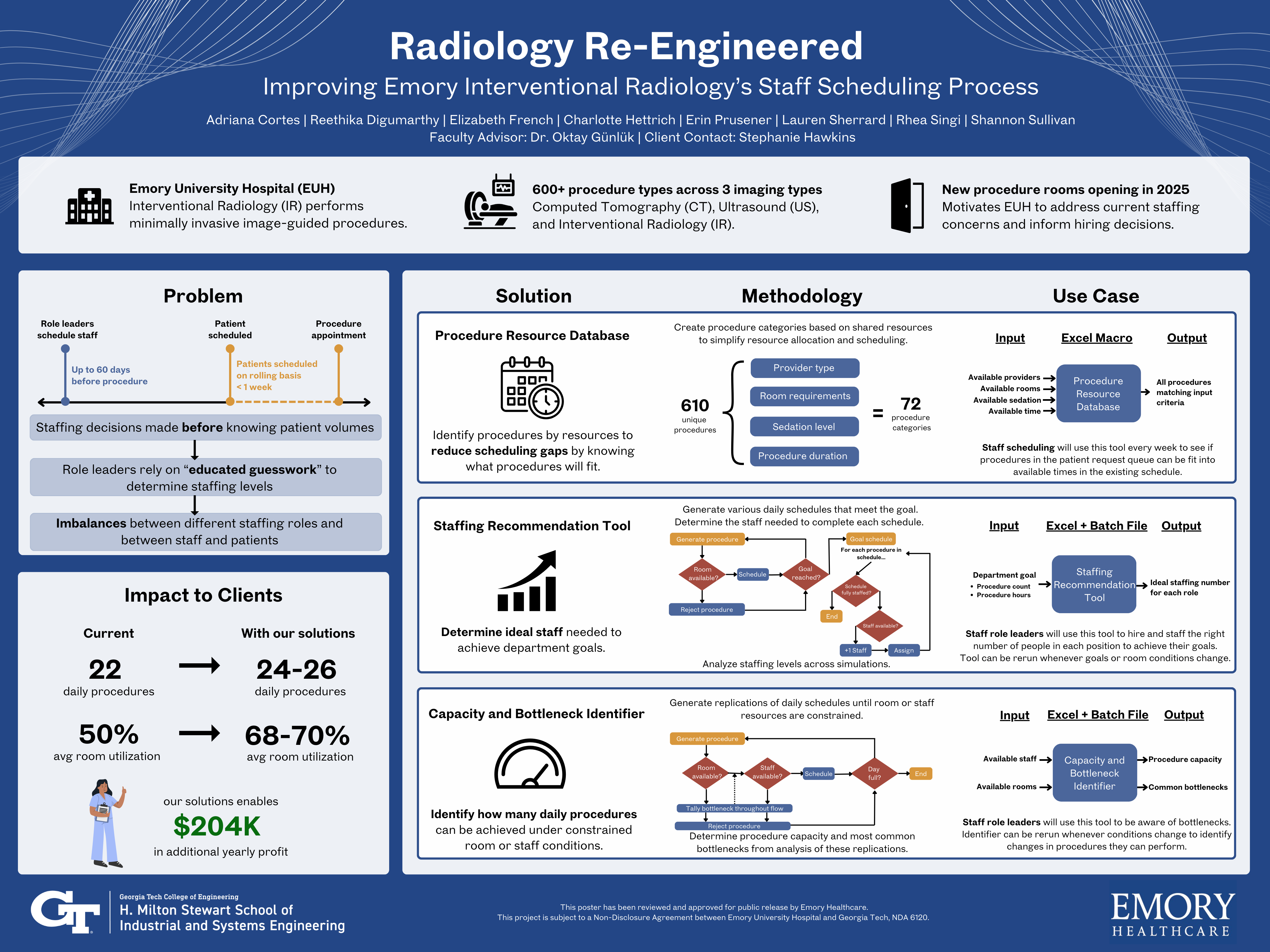
Staffing decisions are made up to 60 days before the day of procedure, while patients are scheduled on a rolling basis from 7 days before the day of procedure up until the day of. This timeline means that staff role leaders rely on personal expertise and what they call “educated guesswork” to determine staffing levels.
EUH currently defers approximately 8.3% of all daily patient requests to other sites because they do not fit into the weekly schedule. However, they average just 50% utilization across all procedure rooms. These metrics indicate that staffing practices are the source of the problem. In 2025, EUH plans to open additional procedural rooms, motivating them to improve their staffing processes to prevent the exacerbation of their current problems.
The team identified three key pieces of information to make informed staffing decisions: (1) the resources needed to complete each procedure, (2) staff needed to achieve the department’s goals, and (3) the number of procedures they can complete with constrained room and staff resources.
The team created three deliverables that each provide information necessary for the client to make informed staffing decisions. Our Procedure Resource Database will allow EUH to quickly find resource information for each procedure, helping enable them to confidently add procedures to scheduling gaps. The Staffing Recommendation Tool will allow EUH to determine how many staff are needed to reach desired department performance goals. Lastly, our Capacity and Bottleneck Identifier will allow EUH to identify how many procedures they can perform with given staff levels and available rooms as well as which resources hinder their performance the most at their current levels.
Using our deliverables, EUH can identify the staffing levels needed to increase their average of 22 procedures per day to 24-26 per day as well as increase their average room utilization to 68-70%. We can project these solutions will enable EUH to realize an additional $204,000 in annual profit.
EUH can continue to use our deliverables as they move forward with their plans to expand procedure space and as conditions change within their department.
Project Information
Student Team
Adriana Cortes, Reethika Digumarthy, Elizabeth French, Charlotte Hettrich, Erin Prusener, Lauren Sherrard, Rhea Singi, Shannon Sullivan
Faculty Advisor

Faculty Evaluator