Poster
Client Context
Emory University Hospital is recognized for its specialized medical services, including its Interventional Radiology department. This department conducts minimally invasive, image-guided procedures using technologies such as X-ray, CT, and MRI. With four procedure rooms, it serves both in-patients and out-patients, many of whom require transportation between the hospital and a nearby patient tower. Efficient patient transport and patient scheduling are vital to the department’s smooth operations, which must balance time-sensitive procedures with resource limitations.
The IR department is currently facing several inefficiencies. Delays during the “Activation-to-Assignment” stage of patient transport contribute to extended room turnover times, creating bottlenecks in patient flow. Scheduling inaccuracies exacerbate these issues, with procedure durations often being incorrect, leading to idle staff and delays in subsequent procedures. These combined challenges frequently result in patient rollovers, where in-patients ready for procedures must be rescheduled for the following day. These factors impact patient care and increase the strain on already limited resources.
Executive Summary
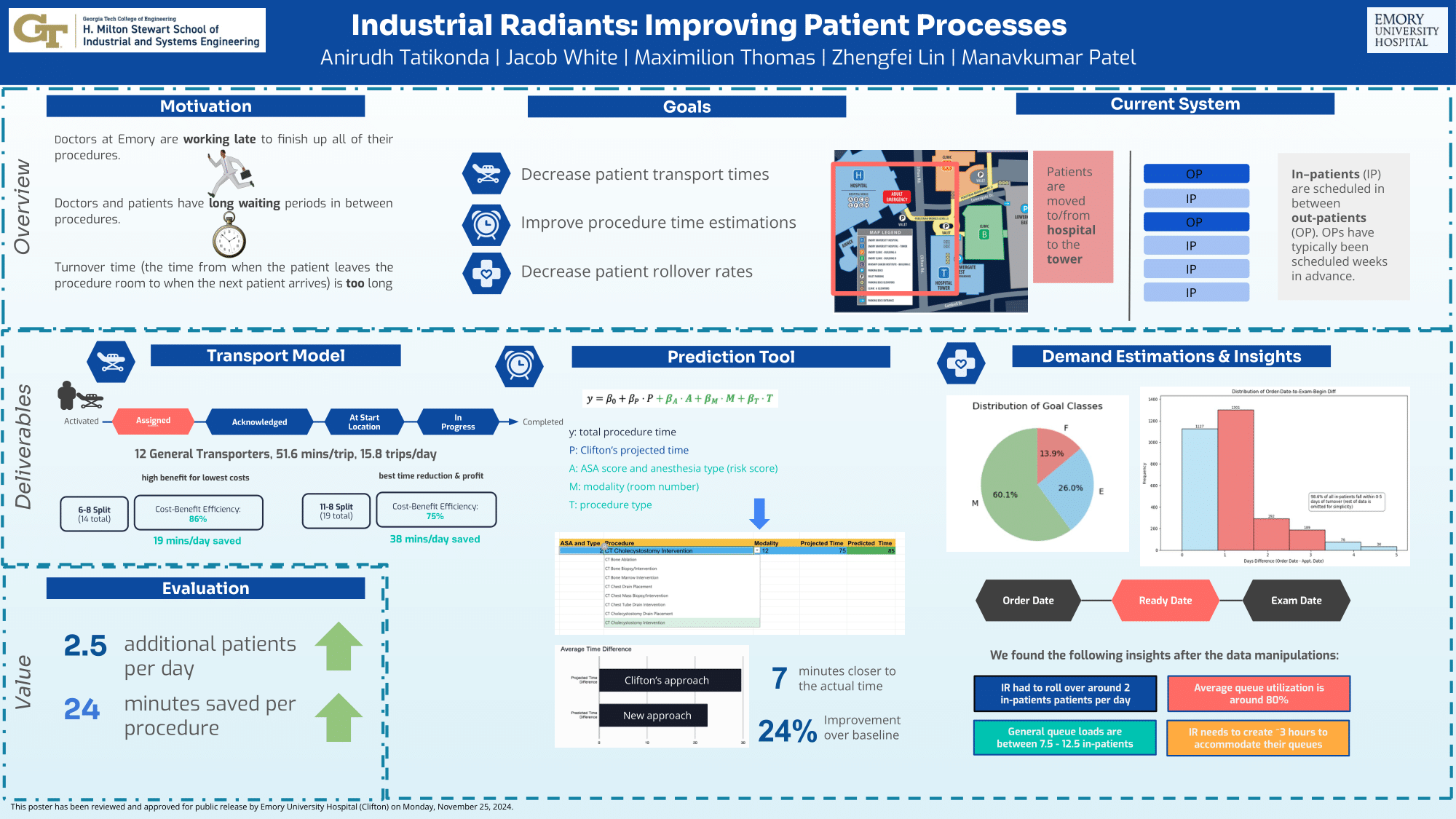
Emory University Hospital's Interventional Radiology (IR) department specializes in minimally invasive procedures using advanced imaging technologies like X-ray, CT, and MRI. The department has four procedure rooms (IR 11, 12, 13, and 14) and serves both in-patients and out-patients who are moved between the hospital and the patient towers. However, inefficiencies in transport, scheduling, and patients rollover extended patient wait times, negatively impacting operational efficiency.
To address these challenges, our project focuses on three objectives: improving patient transport efficiency, enhancing estimations for procedure time allotment, and reducing patient queue rollover rates. Accurate time prediction is critical, as Emory's present process overestimates cases by 29.59 minutes on average, wasting staff hours and causing unnecessary delays. Leveraging historical data, we created a prediction tool that improves the accuracy of time estimations, reducing the error to just 7 minutes—a 23.6% improvement. This enables better scheduling, minimizes idle time, and unlocks additional procedure capacity.
We used Simio to model current patient transport procedures and assess potential improvements. Our baseline model, which was validated against historical data with a 97.5% agreement, indicated average patient transport durations of 52.01 minutes across all departments and 50.60 minutes especially for the IR department. To improve performance, we tried several transporter allocation arrangements and schedules. Our calculations revealed that the ideal arrangement includes 14 general transporters, which reduces average IR travel time by 1.72 minutes each trip and saves around 234 hours per year in transport operations. This improved arrangement not only lowers delays, but also ensures faster room turnover, which could potentially contribute to increased patient volume.
Emory may be able to recoup around 234.85 hours yearly by saving 7 minutes every surgery, allowing for the scheduling of additional procedures. With an average revenue of $6,341.95 per procedure, this represents a potential annual revenue gain of $1.04 million. Furthermore, optimizing transporter allocation can save time, increase staff efficiency, and improve patient satisfaction by lowering wait times.
Project Information
Student Team
Jacob White
Zhengfei Lin
Manavkumar Patel
Anirudh Tatikonda
Faculty Advisor

Faculty Evaluator