Poster
Client Context
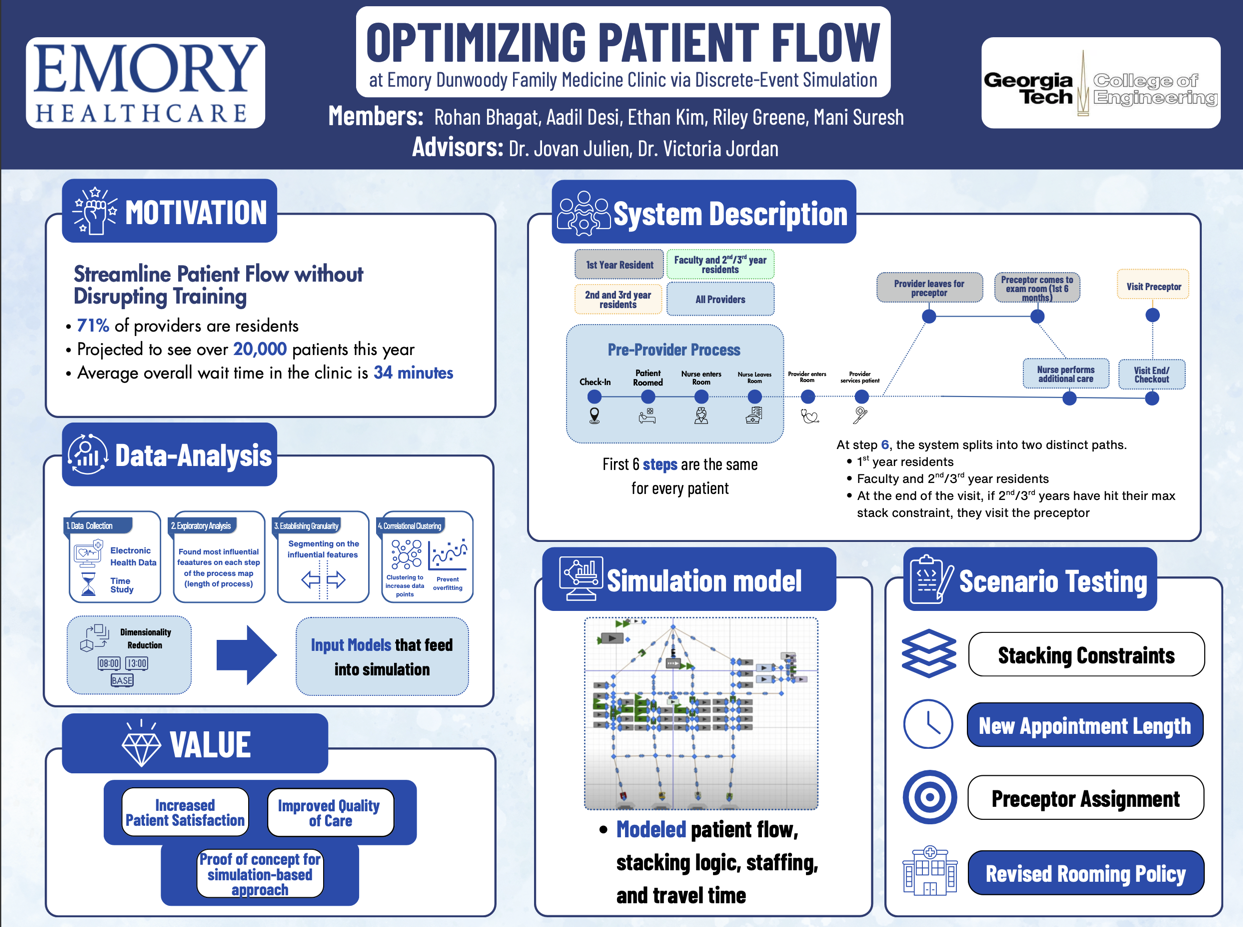
Our client, the Emory Family Medicine Clinic (FMC) at Dunwoody, is a newly established primary care facility that opened in October 2024. This new location consolidated several nearby clinics, creating one multidisciplinary facility, intended to enhance patient experience by offering multiple services at one central facility. The Family Medicine Clinic is located on the third floor of this new location and is projected to serve more than 20,000 patients this calendar year, a figure which the clinic expects to grow in the coming years. As an academic health system, one of the clinic's primary goals is to provide hands-on experience for residents, training them to become fully-fledged, independent doctors of the future.
Emory Healthcare is looking for a simulation-based approach to understand and address problems at FMC now and in the future, recognizing the value and flexibility of using simulation to test several different potential changes to the clinic’s operations. This simulation would be employed by a team of systems engineers, data scientists, and simulation experts working for the Emory Healthcare (EHC) network at large to study the effects of proposed changes.
Executive Summary
Our client is the Emory Family Medicine Clinic (FMC) at Dunwoody. It is a new location, opened in October 2024, that consolidated nearby clinics to enhance patient experience at one central location. FMC is resident-driven teaching facility: 71% of providers at the clinic are residents. To ensure residents are receiving proper training and administering proper care, residents are supervised by preceptors. This resident-preceptor interaction complicates the operations of the clinic and increases patient cycle time.
As FMC faces increases in projected demand, Emory Healthcare is looking for a simulation-based approach to understand and address problems at FMC now and in the future, recognizing the value and flexibility of using simulation to test several different potential changes to the clinic’s operations. Our team identified high wait times at the clinic as a problem such a simulation could immediately address. Currently FMC patients are waiting an average of 34 minutes throughout their visit.
The team analyzed nearly 6,000 records and conducted manual time studies to extract key insights into the clinic’s performance metrics, understand process flow at the clinic, and model the system, careful to work around data limitation issues at the new clinic.
From this analysis, the team has been able to build a well-functioning simulation model for the clinic, and compared its outputs—such as the time it takes a nurse to room a patient and average patient cycle time—were compared against real-world data to ensure accuracy and validity.
The team has also been able to begin using this model to test potential changes to the system, finding that eliminating the one-to-one assignment of preceptors to residents would reduce in-visit preceptor wait times by 31%, reducing patient cycle time and improving patient experience.
The team has developed three key deliverables. First, a simulation model that enables Emory to evaluate the impact of operational changes. Second, a random scheduling generator that produces simulated weekly schedules based on demographic patterns for use within the model, allowing the potential scenarios to be tested on a large randomly generated schedule. And finally, data-driven insights on potential changes the clinic can and should implement.
Project Information
Student Team
Rohan Bhagat, Aadil Desai, Riley Greene, Ethan Kim, Mani Suresh
Faculty Advisor

Faculty Evaluator