Poster
Client Context
Winton Machine Company is a Georgia-based manufacturer that produces highly customized, built-to-order machines for metal tube fabrication. Despite steady demand, the company has struggled to meet delivery deadlines and sought to better understand the root causes of these delays.
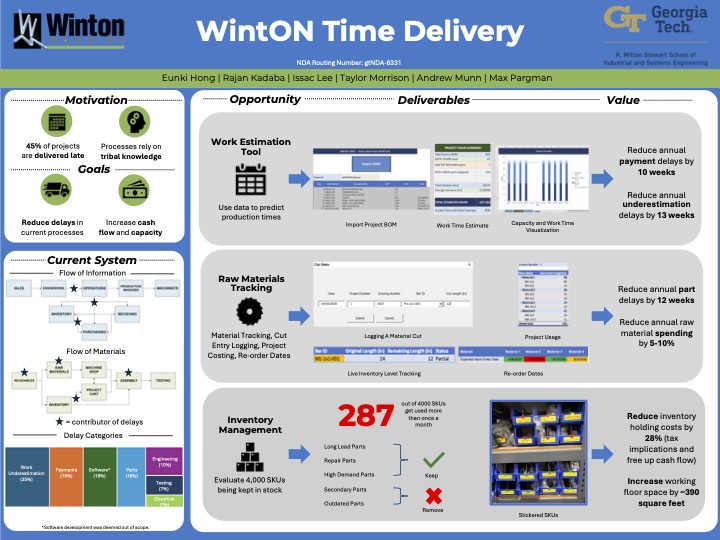
To quantify the issue, the team analyzed weekly status updates from 264 machines produced since late 2022. The analysis revealed that 45% of machines were delivered late, with an average delay of 25 days and a cumulative impact of approximately 105 weeks of delay per year. The primary drivers of delay were identified as manufacturing time underestimation (25%), software development (19%), customer payment delays (19%), and parts-related issues, including procurement and retrieval (16%).
Winton’s production process begins with coordination between sales, engineering, and operations to establish delivery timelines based largely on experience rather than data. This reliance on “tribal knowledge” often leads to overly aggressive schedules, which cascade into downstream delays, particularly in customer payments tied to project milestones.
Inventory management further contributes to inefficiencies. Winton maintains both finished parts and raw materials, but limited tracking and inconsistent processes frequently result in missing or delayed components. Machinists often spend time searching for parts or waiting for materials to arrive, reducing overall productivity and extending project timelines.
While software development delays represent a significant portion of total delays, this area was deemed out of scope due to its proprietary nature. As a result, the project focuses on improving operational efficiency through enhanced inventory management and data-driven production scheduling.
Executive Summary
Winton Machine Company is a privately held manufacturing company headquartered in Suwanee, Georgia. They design and manufacture over 100 different models of built-to-order tube and coaxial cable fabricating machines including tube benders and spool unloaders. Since 2022, Winton’s average time to manufacture a fabrication machine was 25 days longer than expected. Consequently, their on-time delivery rate was only 55%.
Based on Winton’s weekly logs on more than 250 machines manufactured since 2022, we identified the following main components of the average 25-day gap: delays in purchasing and inventory (15%), delays in software development and testing (25%), work stops while waiting for customer payments (20%), and underestimated production times (25%). Since Winton had declared software development to be out of scope, we focused on inventory management and work scheduling through the creation of a work estimation tool, labor capacity dashboard, raw materials tracker, and inventory reduction strategy.
The Work Estimation Tool estimates the number of machining hours required to manufacture the parts for a new project. By grounding delivery date estimates in historical data rather than guesswork, the tool directly combats lateness due to underestimation. The tool also allows Winton to bill customers earlier in the process, reducing delays caused by late customer payments. A Capacity Visualizer was also delivered, which displays the shop floor's current and projected capacity, giving the Production Manager a view of scheduling constraints when setting delivery dates.
The raw material tracking spreadsheet provides expected re-order dates and cost summaries to reduce delays waiting for materials and calculate the cost to be billed to customers. An additional solution is the inventory reduction strategy that categorizes Winton’s four-thousand SKUs into those to keep in stock (long-lead parts, frequently used parts, and high-margin repair parts) and those to be removed (outdated parts, infrequently used/secondary parts).
Our solutions deliver a cumulative 35-week annual decrease in delays, a 28% reduction in inventory holding cost, and a $20,000 reduction in late fees. These improvements foster better relationships with customers, free up cash flow, and increase working floor space.
Project Information
Student Team
Eunki Hong, Issac Lee, Rajan Kadaba, Taylor Morrison, Andrew Munn, Max Pargman
Faculty Advisor

Faculty Evaluator