Poster
Client Context
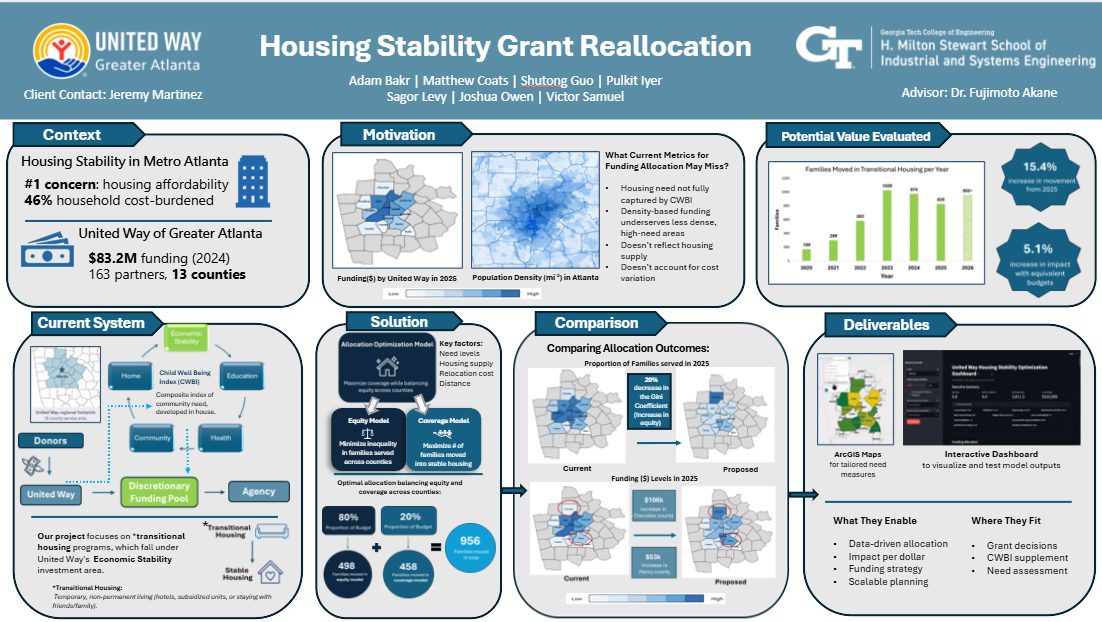
United Way of Greater Atlanta is a nonprofit serving the Atlanta metro area, including thirteen counties. As one of 1,700 chapters across 40 countries, the Greater Atlanta branch focuses on connecting communities with resources that support sustainable and equitable outcomes. Their mission is to ensure access to basic needs, including education and food, with a major focus on children in grades K-12. Through partnerships with community leaders, schools, advisory boards, and other nonprofits, United Way helps children access services that enable long-term stability, regardless of circumstance. United Way allocates grants on a biannual basis, first in February and then in August, deriving their budget from donations and property revenue generated from the previous fiscal year. Once their budget is established for each type of grant, United Way works with other nonprofit organizations/agencies in the thirteen counties to co-design grants, which are then provided to the recipient organizations over a twelve-month period. Because United Way provides aid to thousands across Greater Atlanta, their allocation efforts are executed at the community level, providing money to partner organizations that operate in communities of need that then disperse funding to individuals and families. To account for a variety of community factors, including demographics, economic well-being, and education among others, these communities are defined at various geographical levels. In transitional housing, these partner organizations are often county governments, so United Way determines all transitional housing funding allocations at the county level. The Child Well Being Index or CWBI is a unique measure of need for a community specifically designed by United Way. United Way does not disclose the mathematical formulation behind the CWBI. However, the underlying components of the index are weighted based on importance and are translated into a score from 0 to 100. A score closer to 100 indicates a zip code tabulation area (ZCTA) that excels in each measure and has a relatively high standard of living. In contrast, a ZCTA with a value on the opposite end of the scale demonstrates significant socioeconomic disadvantages and elevated levels of need. United Way also utilizes population densities to allocate funding. United Way factors in the approximate population sizes within each county, ZCTA, and census tract taken directly from the U.S. Census Bureau. The areas and communities that have significantly higher population levels are designated as higher priority in conjunction with the Child Well Being Index. Since peripheral counties like Cherokee and Clayton have lower population densities, United Way’s efforts in these communities have been minimal in previous years. This was a significant area of opportunity for the reallocation of funding.
Executive Summary
United Way of Greater Atlanta is a nonprofit organization that improves the lives of children, families, and communities across thirteen counties in the Atlanta area. United Way allocates grants biannually using funding from donations. To guide decisions, United Way developed the Child Well-Being Index (CWBI), a composite metric based on 16 socioeconomic indicators that identifies priority areas including economic stability, brighter future, college and career readiness, and strong learners. This project focuses on housing-related services within the economic stability area; specifically transitional housing programs delivered in collaboration with partner agencies. Currently, United Way allocates housing and economic stability funding primarily based on the CWBI and population density. While effective for general prioritization, this approach does not fully capture housing-specific needs and may favor higher-population counties over smaller areas with significant but less visible housing needs. This project addresses the need for a more targeted, data-driven allocation framework. Our objective is to maximize the number of families transitioned into stable housing while maintaining equitable funding distribution across counties. To support this, we developed a decision-support tool that integrates: (1) housing-specific need indicators, including estimates of families living in motels and hotels; (2) an impact estimation approach to quantify outcomes per dollar of funding; and (3) an optimization model that balances efficiency and equity in resource allocation. This framework enables United Way to move beyond aggregated metrics and make more actionable, housing-focused decisions. Under a $520,000 budget scenario, the model recommends allocating approximately 80% of funding toward equity-focused distribution and 20% toward coverage maximization. This strategy supports approximately 956 families, representing a 5.05% increase in families transitioned into stable housing while reducing inequity across counties by approximately 20%. These results demonstrate that balancing equity and efficiency can improve overall impact without compromising fairness. The project delivers two tools to support implementation. First, an interactive ArcGIS dashboard visualizes housing need across counties, Second, a Streamlit-based scenario exploration tool allows United Way to evaluate alternative funding levels, housing supply assumptions, and policy constraints.
Project Information
Student Team
Adam Bakr Sagor Levy Joshua Owen Matthew Coats Victor Samuel Shutong Guo
Faculty Advisor
Faculty Evaluator