Poster
Client Context
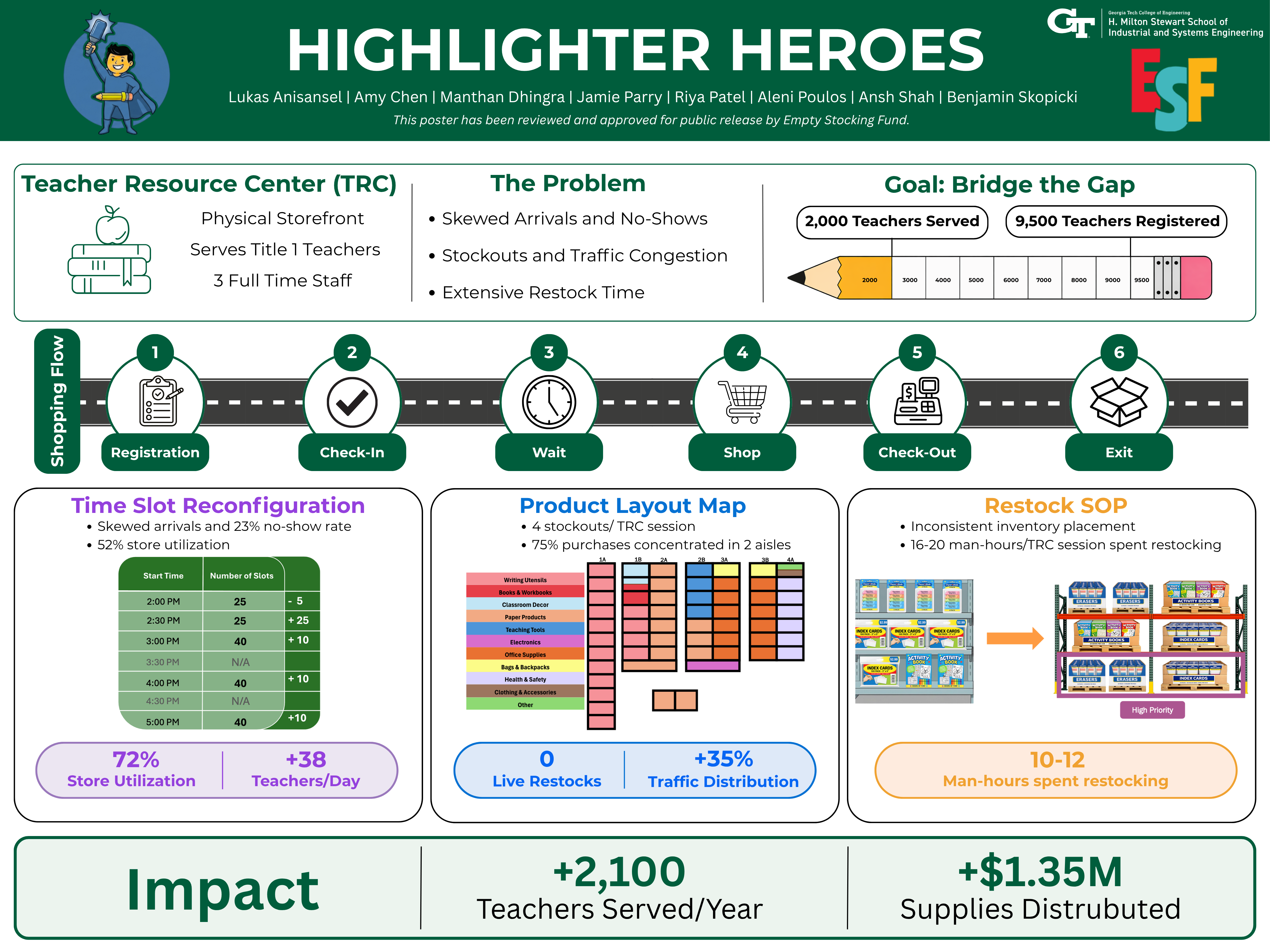
The Empty Stocking Fund (ESF) is an Atlanta-based non-profit that supports Title 1 teachers through its Teacher Resource Center (TRC). The TRC operates as a small-scale storefront within the ESF warehouse, where registered teachers spend a $500 annual credit to shop for classroom supplies. ESF primarily relies on in-kind donations to stock the TRC, occasionally purchasing products to fulfill needs. Currently, three full-time staff members manage all TRC and warehouse operations, supplemented by occasional volunteer support.
Executive Summary
In 2025, the TRC operated seasonally (from July-October), serving roughly 2,000 teachers. However, 8,000 teachers expressed interest to shop in the TRC by the end of 2025, and demand continued to grow to 9,500 by early 2026. To address this disparity, ESF is transitioning the TRC to a year-round model. While this shift increases the number of teachers served to an estimated 5,000 teachers annually, a significant gap of 4,500 teachers remains. The primary goal of this project is to meet the demand, supported by improvements in operating efficiency to enable higher TRC throughput.
Through time studies, the team identified low shop utilization (52%), indicating unused capacity and an opportunity to increase the number of teachers served daily. To evaluate alternate shop schedules, a simulation model was built with the goal of maximizing shop utilization, while avoiding the shop reaching maximum capacity, causing waiting. After implementing the chosen time slot schedule, shop utilization increased by 20% while teacher shop and wait times were unaffected. Also, 50 teacher slots were added to the daily schedule. Accounting for an observed no-show rate, ESF is projected to now serve about 7,100 teachers annually, an increase of 2,100 teachers.
The new schedule increases shopper volume by 37%, posing aisle congestion and product stockouts as operating risks. To mitigate these risks, the team created a product layout map. Sales data were used to balance high-demand products across all shop aisles, distributing congestion. Shelf space was then allocated proportionally to volumetric product outflow to prevent stockouts. Post-implementation data from 2 days showed stockouts dropped from 4 per event to 0. Aisle demand also stabilized, ranging from 13%-34% compared to the previous 5%-50%.
TRC restocks require 16-20 labor hours per session, which is unsustainable for ESF’s small operation and is expected to increase as the number of teachers served grows. To address this, the team developed a reserve area layout and a standard operating procedure for restocking. The proposed reserve area layout mirrors the shop aisles, organizing product locations and incorporating demand-based priority slots to increase inventory visibility and accessibility. Batch replenishment and whiteboard labels were also recommended to reduce search and restock time. These improvements are projected to reduce total restock time by 40%.
Upon observing inefficiencies in the check-in process, the team created clear entrance signage and rewrote lengthy pre-arrival emails, reducing average check-in time by 47%. For long-term growth, the team also explored a radical redesign approach to address ESF’s current operating hard constraints: forward pick at lower level, with reserve above. Adopting this new store model would serve approximately twice as many teachers, or 240 per day.
Project Information
Student Team
Lukas Anisansel, Amy Chen, Manthan Dhingra, Jamie (James) Parry, Riya Patel, Aleni Poulos, Ansh Shah, Benjamin Skopicki
Faculty Advisor

Faculty Evaluator