Poster
Client Context
American Airlines is a global airline headquartered in Dallas–Fort Worth, Texas, operating over 2.1 million flights annually across geographies. Its operation consists of 6000+ daily flights coordinated by the Integrated Operations Center (IOC), which serves as the centralized nerve center of daily flight operations. The IOC brings together dispatchers, crew scheduling, maintenance control, and network planning teams to monitor flights in real time and make coordinated decisions that keep the airline running safely and efficiently.
To support these operations, the IOC partners with specialized internal teams, including the Operations Research Advanced Analytics (ORAA) team-our client. ORAA develops data-driven optimization models and machine learning systems to improve crew scheduling, flight planning, routing, and disruption management, functioning as an internal analytics and consulting arm of American Airlines.
Executive Summary
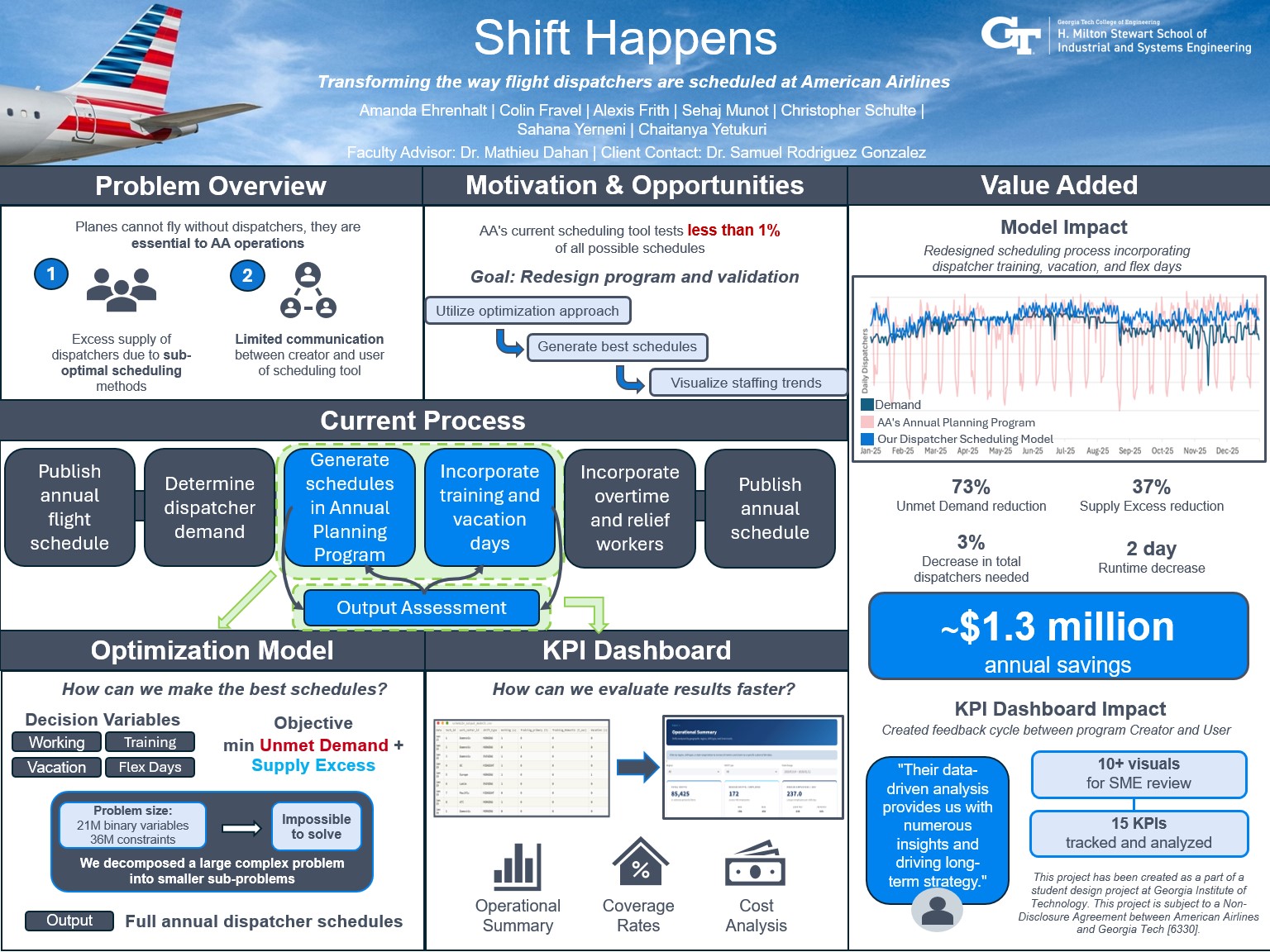
Flight dispatchers are the backbone of safe airline operations, coordinating flight plans, assessing air traffic constraints, and continuously monitoring every flight from takeoff to landing. At American Airlines, the Integrated Operations Center (IOC) and Operations Research and Advanced Analytics (ORAA) teams collaborate to develop annual dispatcher schedules that ensure adequate flight coverage throughout the year. The current scheduling system relies on a series of sequentially executed programs driven by suboptimal, heuristic-based algorithms, which can propagate errors throughout the process. Therefore, the schedules generated are highly variable with instances of significant overstaffing and understaffing. As a result, American Airlines leadership is seeking a more rigorous, data-driven approach to improve dispatcher staffing decisions.
The primary objective of this project is to redesign the dispatcher scheduling system by: (1) developing an optimization-based approach for generating dispatcher schedules that satisfies required demand while adhering to operational constraints, and (2) providing quantitative performance metrics that enable cross-functional collaboration between IOC and ORAA, supporting ongoing model validation and improvement.
To achieve these goals, the team developed the Dispatcher Scheduling Model, a mixed integer optimization model, that creates full annual dispatcher schedules based on variable demand and accounts for absences like training and vacation. In addition, the team implemented an insights dashboard that supports both model validation and facilitates communication between ORAA (creator) and the IOC (user) with quantitative diagnostics.
The Dispatcher Scheduling Model will improve several parts of their current process, producing an estimated cost savings of $3.4 million annually. Furthermore, the model consolidates previously separate programs, minimizing downstream manual revisions and reducing dependence on costly overtime and relief dispatchers that the previous system routinely required. The implementation of the KPI dashboard creates a structured feedback system, leveraging quantitative insights to review schedules effectively.
The redesign provides American Airlines with a data-driven approach to scheduling dispatchers and evaluating system outcomes. Together, the optimization model and KPI dashboard equip the IOC and ORAA with the visibility and analytical insights needed to evaluate staffing outcomes and drive more informed, continuous improvements to the dispatcher scheduling process.
Project Information
Student Team
Amanda Ehrenhalt, Colin Fravel, Alexis Frith, Sehaj Munot, Christopher Schulte, Sahana Yerneni, Chaitanya Sri Yetukuri
Faculty Advisor

Faculty Evaluator