Poster
Client Context
The primary client for this project is the Georgia Tech Registrar’s Office, in collaboration with Georgia Tech Strategic Consulting. The Registrar oversees the academic calendar, registration systems, and schedule of classes that support student enrollment across the university. This project focuses specifically on the first-year registration process during Georgia Tech’s FASET orientation program, where incoming students attend advising sessions and register for fall courses prior to the start of the academic year. The system involves coordination among the Registrar, academic departments, schedulers, and FASET organizers to determine course capacities, distribute seats across orientation sessions, and monitor registration outcomes. The project concentrated on the top 20 freshman courses, which account for a majority of first-year enrollment activity, and studied how course demand estimation, seat allocation practices, and registration monitoring influence students’ ability to obtain full-time schedules during orientation.
Executive Summary
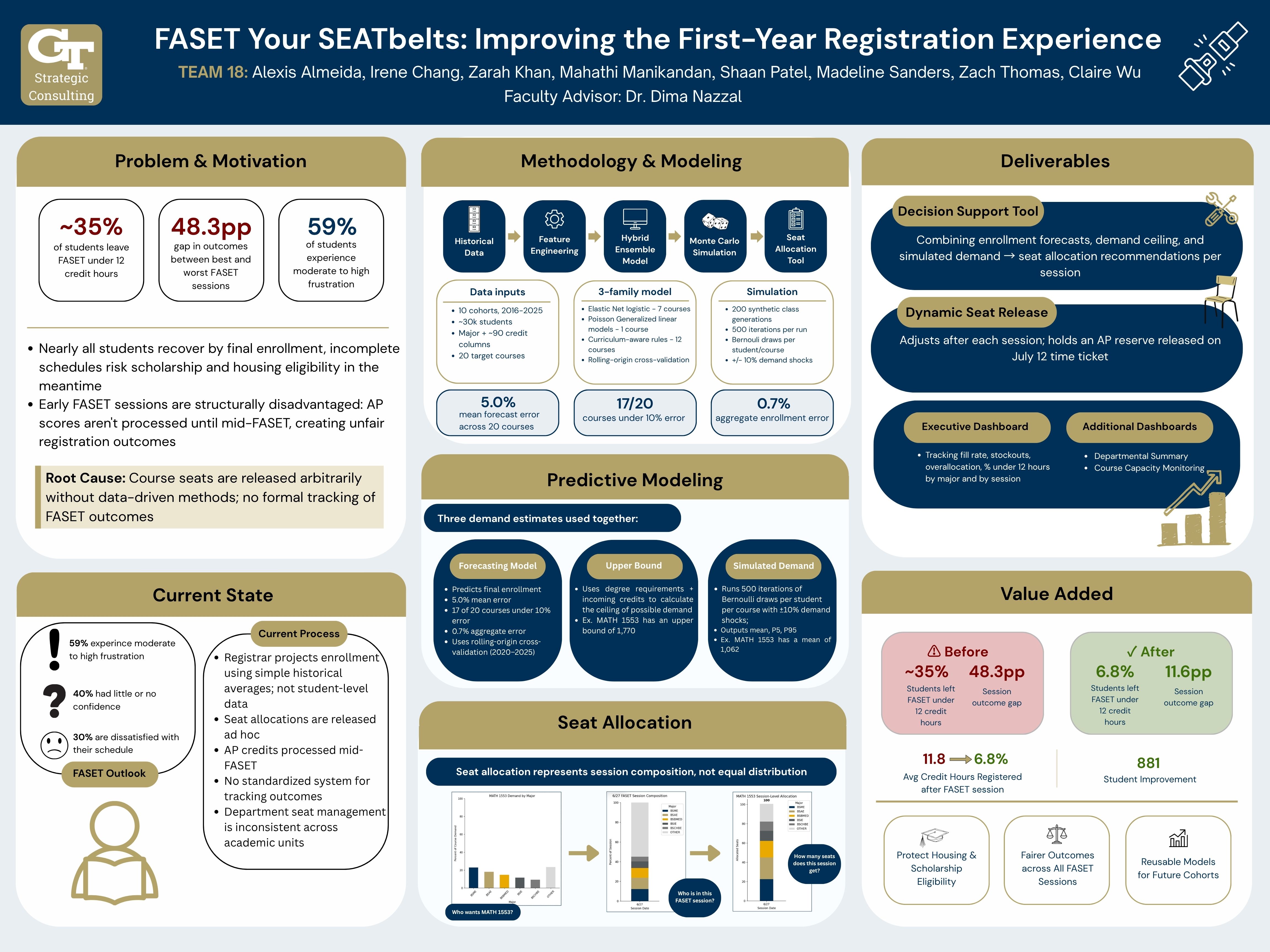
Georgia Tech’s FASET orientation is the first point at which incoming students register for fall courses, yet from 2023-2025 approximately 35% left without a full-time schedule of 12 or more credit hours. Outcomes varied sharply across session dates: students attending sessions before AP scores were released faced under 12-hour rates exceeding 50%. Although most students had full-time schedules by final enrollment, the pattern showed that access during orientation was uneven.
An integrated decision support framework was developed for first-year registration planning to address this for the Georgia Tech Registrar. The work focused on the top 20 freshman courses and targeted three connected gaps in the current process: limited visibility into true course demand, inconsistent seat release practices across sessions, and weak real-time monitoring of registration outcomes.
To improve demand visibility, the team developed three complementary estimators: an enrollment forecasting model, an upper bound calculator, and a demand simulation. Together, these methods produce a practical demand range for each course rather than a single point estimate. The team then developed a dynamic seat allocation framework that distributed FASET seats across sessions based on expected demand and session composition, carrying unused seats forward across sessions and holding a reserve for students who attended before AP scores were released.
When applied to 2025 registration data through simulation, the framework demonstrated improvements in outcomes: the percentage of students leaving FASET below 12 credit hours fell from 32.9% to 6.8%, the gap between the best and worst sessions fell from 48.3 to 11.6 percentage points, and average registered credit hours increased from 11.8 to 15.3. Under simulation, the framework projects approximately 881 additional students would have completed FASET with a full schedule.
The team recommends adopting the proportional seat allocation framework and establishing post-AP registration time tickets for FASET 2026. The dashboard connects to Banner and incorporates the demand estimation tools into the February capacity planning cycle. Deliverables include a Python-based demand estimation framework to guide course capacity planning, a seat allocation tool with a Tableau interface for schedulers, and a real-time monitoring dashboard.
Overall, this project shows that Georgia Tech can improve the first-year registration experience through a coordinated, data-driven planning process. Although the framework does not replacedepartment judgment on section-level decisions, it provides a practical foundation for improving access, fairness, and transparency in FASET registration.
Project Information
Student Team
Alexis Almeida, Irene Chang, Zarah Khan, Mahathi Manikandan, Shaan Patel, Madeline Sanders, Zach Thomas, Claire Wu
Faculty Advisor

Faculty Evaluator