Poster
Client Context
Emory Healthcare, the largest healthcare provider in the state of Georgia, has had an uptick in healthcare-acquired infections (HAIs) in the past year. This project, more specifically, takes place inside an Emory Healthcare University Hospital intensive care unit (ICU) located in Druid Hills, GA. The ICU this project is oriented around is focused on liver-related issues such as transplant and rehabilitation.
Executive Summary
Emory Healthcare, the largest healthcare provider in the state of Georgia, has had an uptick in healthcare acquired infections (HAIs) in the past year. This project, more specifically, takes place inside an Emory Healthcare University Hospital intensive care unit (ICU) located in Druid Hills, GA. The ICU this project is oriented around is focused on liver-related issues such as transplant and rehabilitation.
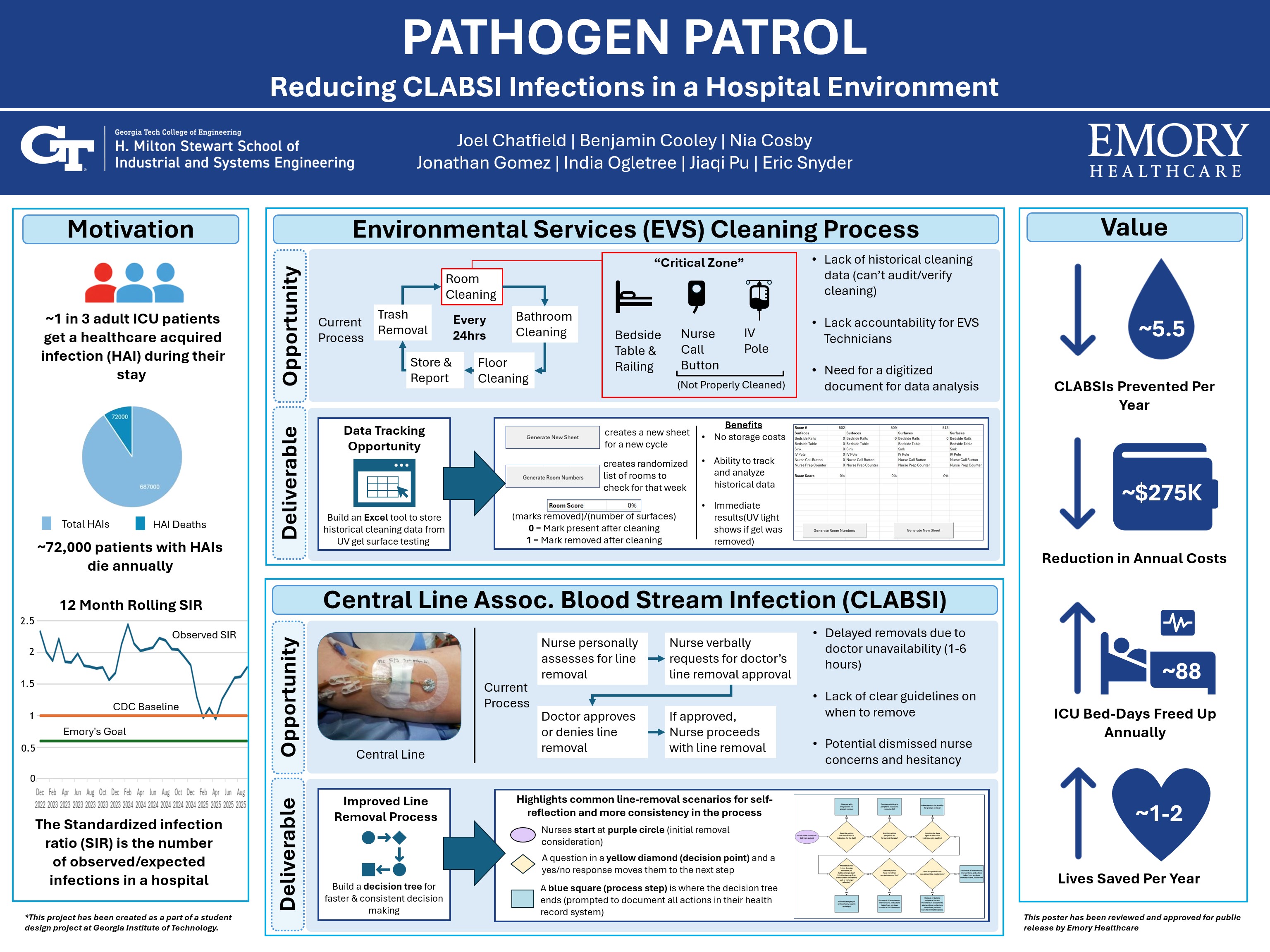
This project has two focus areas: (1) environmental services (EVS) technician cleaning procedure and (2) central line associated infections (CLABSIs) prevention. EVS technicians are the staff responsible for routine cleaning and sanitization of individual patient rooms every day. Central lines are intravenous lines that reach near the heart for delivery of medications and other therapies. Central line associated bloodstream infections (CLABSIs) occur when bacteria or fungi enter the bloodstream through these lines.
For (1) the environmental services (EVS) technician cleaning procedure, the opportunity lies in fostering greater awareness of the effectiveness of the cleaning process. To do so, we’ve utilized surface testing methods to identify whether a surface has been cleaned or not. Our proposed solution here is to create a tracking system using Excel to audit rooms and create a metric to evaluate EVS effectiveness against HAIs.
The opportunity for (2) CLABSI prevention lies in the current central line removal process. The two main problems encountered include the lack of standard removal, meaning each nurse completes the process differently and long lead times for central line removal (approximately 1–6 hours). Our proposed solution is to create a central line removal decision tree to streamline and standardize this process.
Implementation of the proposed solutions is projected to save an estimated 1-2 lives and roughly $275,000 in additional patient costs annually. By deploying our central line removal decision tree and Excel-based cleaning audit system, we aim to standardize nurse and EVS workflows and encourage accountability. These process improvements are estimated to cut CLABSI cases by approximately 50% and free up capacity for an additional 88 ICU bed-days per year.
Project Information
Student Team
Joel Chatfield, Benjamin Cooley, Nia Cosby, Jonathan Gomez, India Ogletree, Jiaqi Pu, Eric Snyder
Faculty Advisor

Faculty Evaluator