Poster
Client Context
The client for this project is the Industrial Engineering Division of Wellstar Health System. Our project focuses specifically on the Imaging Center at Vinings Health Park, which is part of Wellstar’s network of Health Parks across Georgia. Wellstar’s Industrial Engineering Division supports operational improvement initiatives across the system. Their goal is to increase patient throughput in all of their health parks, therefore increasing revenue, while maintaining excellent patient satisfaction.
Project Objective
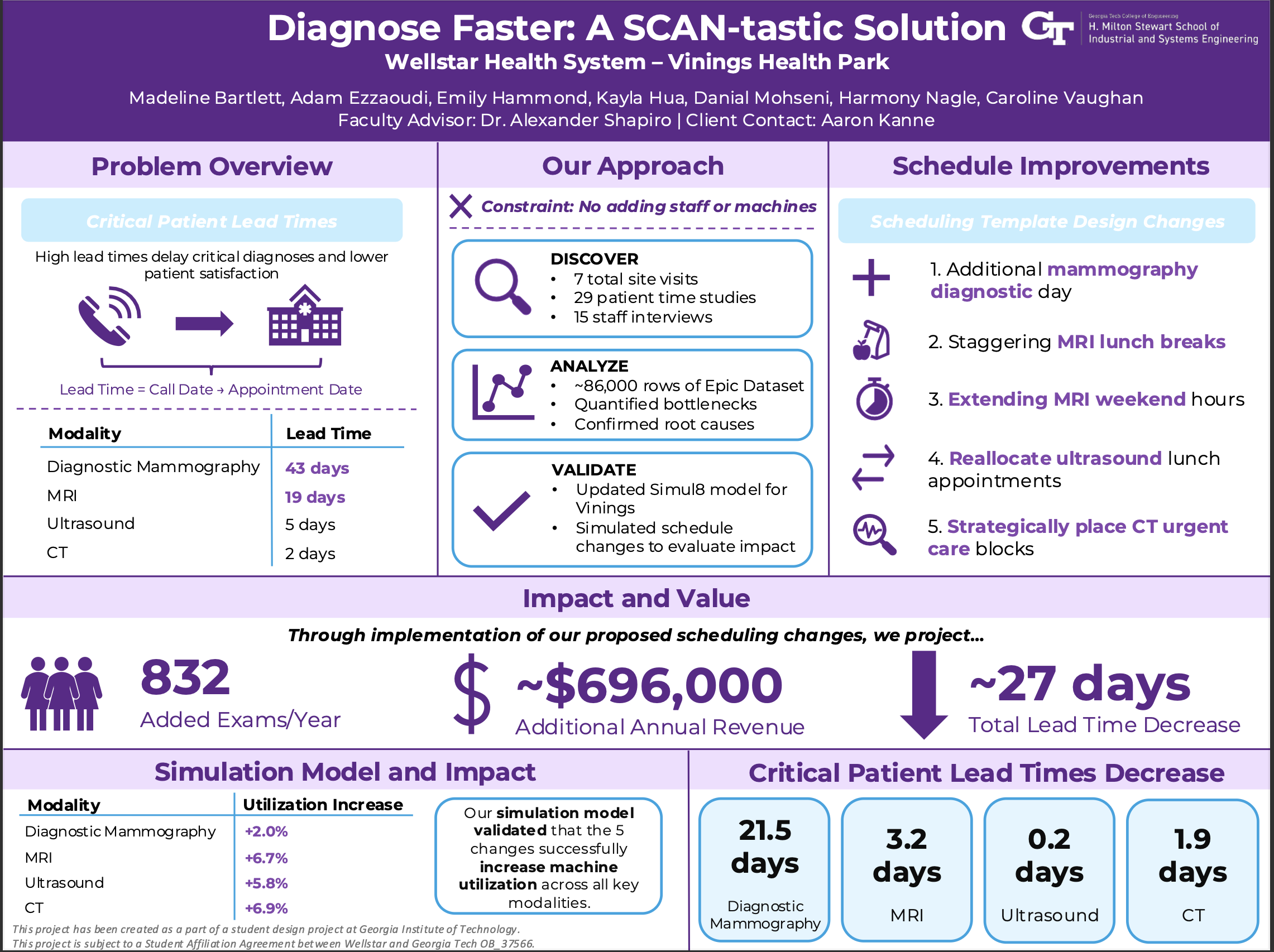
The Vinings Health Park (VHP) Imaging Center, a critical part of the Wellstar Health System, is severely impacted by long patient lead times. As of August 2025, patients faced delays of up to 43 days for a diagnostic mammogram and 19 days for MRI. These long wait times hinder timely patient care and risk significant loss of revenue and patients to competitors.
The core problem is inefficient scheduling practices that limit daily throughput. Our project's objective is to increase patient throughput and unlock hidden capacity by implementing operational scheduling design changes, critically, without adding any new machines or staff.
We have identified five high-impact, non-capital-intensive scheduling adjustments across Mammography, MRI, Ultrasound, and CT that directly address these inefficiencies:
- Mammography by adding a second diagnostic day through the conversion of existing screening slots;
- MRI by both staggering technologist lunch breaks and extending weekend hours to increase machine uptime;
- Ultrasound by shortening the scheduled lunch block to the contracted 30 minutes, which frees up an afternoon slot; and
- CT by shortening and standardizing Urgent Care blocks to free up capacity for routine appointments.
These opportunities are essential because they directly move Wellstar closer to its objectives of increasing patient throughput and revenue. When implemented, the combined changes are projected to:
- Reduce total lead time by 26.84 days, with the Mammography change alone cutting the diagnostic wait time by over 21 days.
- Add 832 appointments per year into the system.
- Generate an estimated $695,000 in additional annual net revenue by better utilizing existing resources.
By acting on these changes, VHP can immediately address its critical backlog, improve patient satisfaction with faster care access, and realize significant financial returns.
Design Strategy
Our approach combines qualitative on-site diagnostics with quantitative analysis. We grounded our understanding of the current system through seven site visits, utilizing 26+ hours of direct observation and 15 staff interviews to identify operational bottlenecks. We then triangulated this observational data against a robust historical dataset of 86,914 records from the client's Epic system, ensuring our design inputs were statistically representative of the facility’s actual capacity constraints and demand variability.
Leveraging these insights, we designed a strategy focused on "uncovering hidden capacity" through five specific operational adjustments to the scheduling templates.
To validate the feasibility and quantify the impact of these changes, we utilized a discrete event simulation model built in Simul8. We calibrated the model to strictly reflect the physical and operational constraints of Vinings Health Park and validated its accuracy against historical performance data. By running randomized trials that compared a "current state" baseline against our proposed "future state" design, we stress-tested all five recommendations in a risk-free environment. This simulation confirmed that our design would yield significant improvements in patient throughput and machine utilization, providing data-driven justification for implementation.
Deliverables
The main deliverable for this project is an alternative scheduling template for the Vinings Imaging Center which highlights our proposed changes to increase scheduling efficiency through added appointments and reallocated slots. It is provided as an Excel spreadsheet so the client can easily reference and implement updates within the Epic scheduling system. Because Epic cannot automatically import schedule changes, the template is designed to be practical and user-friendly, enabling staff to adopt the new schedule without disrupting current operations.
Our other deliverable is the simulation model that we used to test and validate our recommendations. Wellstar specifically requested the modified model so they can use it for future observations and testing. While the overall patient flow remains similar between East Cobb and Vinings, input parameters were updated to reflect Vinings' operations. Wellstar will use this simulation model in the future to test other potential design changes.
Value and Impact
Across all scheduling changes, the combined impact on the Vinings Imaging Center is both operationally meaningful and financially substantial. Together these recommendations will reduce total lead time across modalities by 26.84 days, increase machine utilization by 18%, add 832 appointments per year, and generate an estimated $695,000 in annual revenue.
These improvements are also expected to enhance patient experience through the reduction of lead time. For patients facing serious or life-altering conditions, earlier appointments can directly influence their care pathway and provide faster clarity on potential next steps. Increasing appointment availability also offers patients greater scheduling flexibility, reducing frustration and making the imaging process more accessible.
These recommendations support more timely access to imaging services within the Vinings community, which can improve care outcomes and reduce stress associated with waiting for appointments. Because all improvements leverage existing staff and equipment, the environmental impact is minimal, and no additional infrastructure is required.
Project Information
Student Team
- Madeline Bartlett
- Adam Ezzaoudi
- Emily Hammond
- Kayla Hua
- Danial Mohseni
- Harmony Nagle
- Caroline Vaughan
Faculty Advisor

Faculty Evaluator