Poster
Client Context
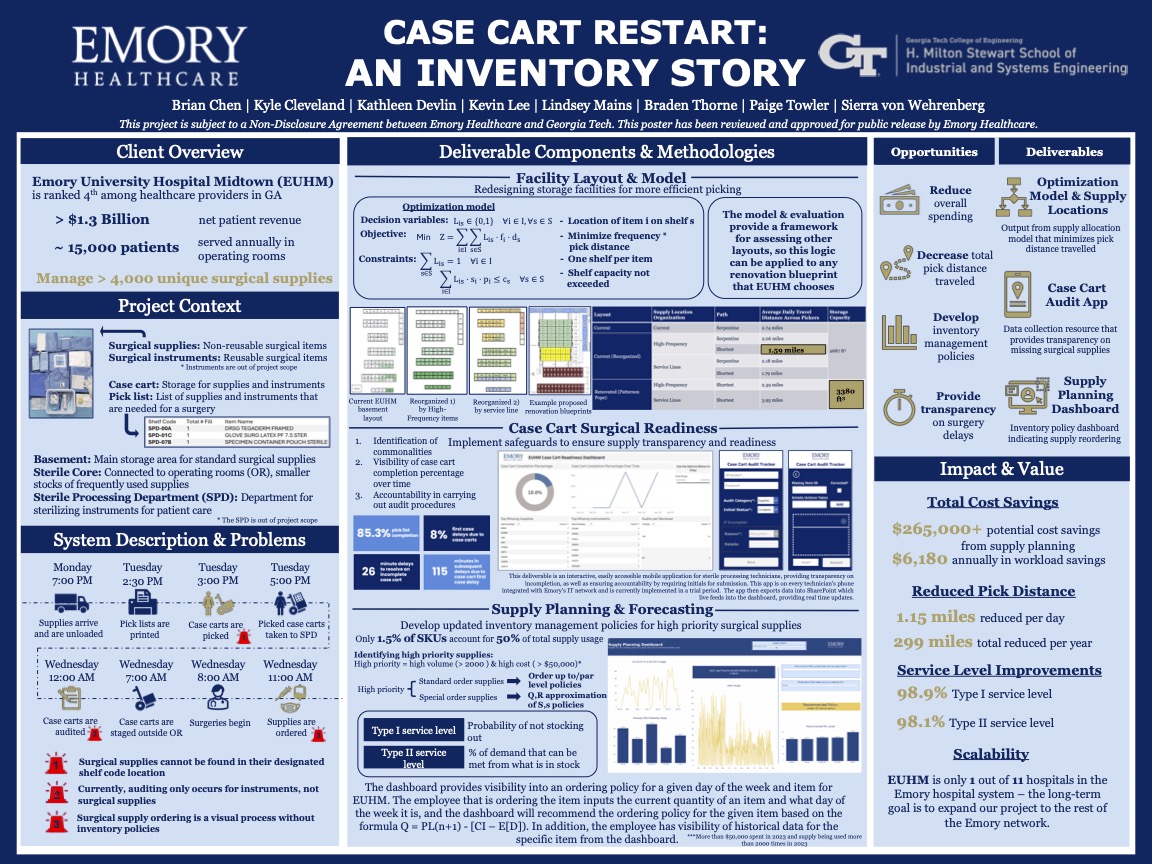
Emory University Hospital – Midtown (EUHM) is a leading member of the Emory Healthcare system, serving 15,000 surgical patients annually with 60 surgeries per day across 28 operating rooms, generating $1.3 billion in annual net revenue. EUHM manages over 4,000 surgical supplies and 1,000 sterile instrument trays, with supplies and instruments combined in "case carts" for each surgery.
Executive Summary
Emory University Hospital – Midtown (EUHM), is a predominant member of the Emory Healthcare system, serving 15,000 surgical patients per year, performing 60 surgeries per day across 28 operating rooms, and bringing in $1.3B annually in net revenue. To meet the surgical needs of patients, EUHM manages over 4000 unique surgical supplies and over 1000 sterile instrument trays. Surgical supplies and sterile instruments are combined in “case carts” prior to each surgery.
The team engagement is concerned with the management of surgical supplies. . EUHM has expressed three key needs: reduction of overstock and stockout of surgical supplies, improved organization in the locations of surgical supplies in the basement storage area, and mitigation of surgical delays related to missing supplies. It is estimated that 4% of surgeries are delayed due to not having all the needed surgical instruments or supplies in time before surgery.
To reduce overstock and understock, the team identified priority supplies by cost and volume and proposed new inventory policies for these supplies, which are estimated to improve service levels by 28-33%. Improving serving levels is estimated to reduce surgery delay costs by ~$1.2M per year. The team developed an interactive dashboard to provide visibility to the updated recommended supply levels and facilitate the implementation of these policies.
To redesign facilities for greater efficiency in picking, the team explored two potential scenarios: allocating high-frequency supplies closer to the entrance and placing items on shelves by service line. By reorganizing the current layout by frequency, the team found a reduction of 1.15 miles travelled per day. This figure equates to ~300 miles or $6,000-$7,000 of workload savings per year. The team also provided the framework for reorganization of supplies to enable the assessment of other layouts as well.
Currently, EUHM verifies that the needed instruments are included in a case cart the night before surgery, but they do not audit supplies. To improve the audit process, the team recommended auditing supplies in addition to instruments, and developed a digital audit app to collect data on the auditing process. Additionally, the team built a dashboard to visualize the data collected by the app, enabling identification of commonalities in incomplete case carts, providing staff with visibility to case cart completion over time, and increasing accountability for the supply chain technicians carrying out the audit procedures. Implementation of the audit app is estimated to reduce the $1.6M annual cost attributed to surgery delays.
Project Information
Student Team
Braden Thorne
Kyle Cleveland
Lindsey Mains
Kathleen Devlin
Paige Towler
Brian Chen
Kevin Lee
Faculty Advisor

Faculty Evaluator